
EviSmart designs now land automatically in your lab’s Oqcam account named, routed, and ready to nest. The last manual step between design and mill is gone.
EviSmart now sends designs directly into your Oqcam account. Files are named, shade and material are attached, and each case is routed to the correct mill automatically. Combined with automated intake and design, a case can move from your scanner platform to a puck on the mill without anyone opening a folder.
Look at the workflow hundreds of EviSmart labs already run. A case comes out of their scanner platform automatically, gets booked, moves into production, gets designed and passes QC.
Then everything stops. A technician downloads the design files from their CAD software or outsource partner's portal. They drop it into a CAM folder, open their nesting software, orient every unit, and place the sprues, spending three to five minutes per case. Then they do it again for the next one, and the one after that.
In a workflow where nearly every other step is automated, having a CAM technician, one of the hardest roles in the building to hire, spend their mornings moving files around instead of pushing cases through to finishing raises the cost of every crown that leaves the building."
For years, CAM software lived on one machine in one room. The CAD/CAM tech would gather up a batch of finished designs and nest them all at once, or a remote nester would log into that machine and do the same thing. Either way, nesting happened when a person sat down to do it. There was no automation to connect to, so nothing upstream could feed it.
Oqcam changed that. As dentistry's first cloud-based automated CAM platform, it allows labs to drag and drop batches of cases into the software and have them ready-to-mill in seconds, without needing a technician to manually orient and nest every case. By bridging the gap between design and fabrication, it solved one of the last pieces of the puzzle in automating the dental lab workflow.
What it did not change is how a case gets there. The software still receives a mesh file and nothing else. No shade, no material, no indication of which of your mills or printers the case belongs on.
So that information has to travel some other way, and the convention that labs settled on is the filename. A lab tech manually renames the design files according to the fabrication details and the automation reads it from there.
It works. It also means every case needs a person to type it correctly, one wrong character breaks production, and labs write internal naming standards specifically to survive it.
In beta testing we found CAM technicians spending 10 to 20% of the working day on the manual handoff, and at higher case volumes it sat closer to a fifth of the day.
At one lab that number belongs to a single employee who designs, nests and runs the mill, which means the lab's entire production capacity is one person's availability. The manufacturing lead at another described the routine as "search number, wait, pull, drag." Their verdict on removing it was that it would be "a huge time saving piece."
Another lab owner named the constraint directly:
"I'm not going to be able to really grow unless I start to hire CAM technicians. They're truly tough to hire, tough to retain - that job can be done remotely."
That constraint only exists because a manual step was left sitting between two systems that didn’t talk to each other. Gaps like that snowball into hiring problems at scale, especially in a trade where staff are harder to find every year.
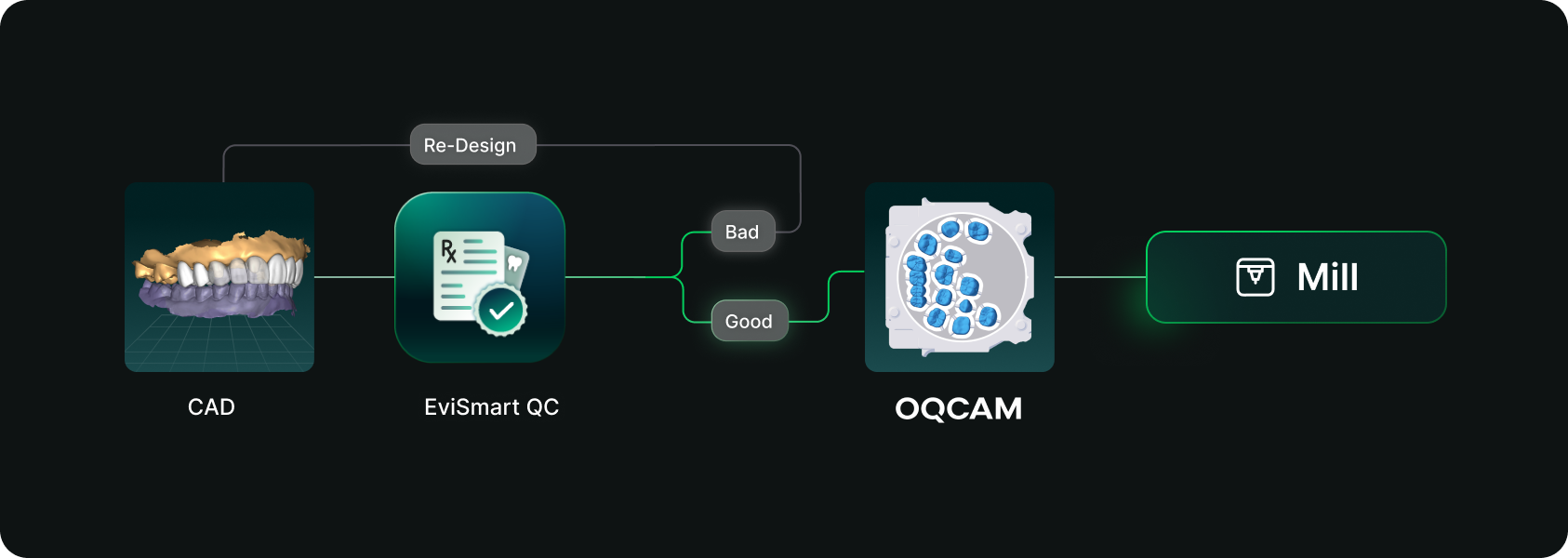
Designs you order from EviSmart arrive in your Oqcam already formatted. Named the way your nesting rules expect, with shade and material attached, and pointed at the machine that case belongs on.
The routing is decided per case. An implant case sends the crown to the mill and puck you cut implant crowns on, and the model to the printer you print models on. Different case types, different machines, chosen automatically rather than by a tech working through a dropdown for every file.
The trigger is QC approval. EviSmart designs your cases your way. The same team works on all your cases and learns what a good case looks like to you. Once your case passes our QC, it triggers a greenlight to send the design directly into your Oqcam account in under a minute.
Once the file arrives in your Oqcam, all your CAD/CAM technicians can review the nested design before starting the mill. That final QC step does not change and is not meant to.
Setup is one session. We connect your Oqcam account and agree where each of your products should go, using the routes and materials you have already built there. Nothing new to create, and you only revisit it if something changes.
Automatic sending only works if you trust what is being sent. Once a case is nested it gets cut, and a design that was not right is wasted material.
You choose what flows. During setup we map only the case types you want moving on their own. Anything unmapped never sends. It waits for you exactly as it does today.
Most labs start narrow. Bread and butter work first, night guards and posterior single units, then widen once they have watched it run for a few weeks. The lab that has been live longest started exactly there and has added case types since.
Your approval stays. This removes the file shuffling between design and CAM. It does not remove your eyes from the build.
For labs outsourcing design work the math gets compelling somewhere north of 30 cases a day into nesting, because that is where the handoff stops being an annoyance and starts being a role.
Not touchless design. Touchless handoff. Every step in that chain that requires judgment should keep requiring judgment, and every step that never did should stop requiring a person.
Nesting requires judgment. Confirming a build requires judgment. Renaming a file so software can read it does not, and never did. It was a workaround that quietly became somebody's job.
Nobody pays you to rename files.


