

Every dental lab has one. You probably know exactly who yours is.
They arrive first. They know every product code in your lab management system by memory. They know which cases to prioritize, when to check their email for a missing shade, which portals to check manually and when. They know which cases need a callback before they go to design, and which practices are fine waiting until end of day.
They are not just doing their job. They are your intake system, your quality filter, your client relationship layer, and your production triage, all in one person.
And if they call in sick tomorrow, you already know what happens.
By the second hour of their absence, cases that should be in production are still sitting in portals. Someone else is trying to figure out which ones are urgent. The LMS is showing a queue nobody knows how to triage. A dentist practice calls about a case status and whoever answers does not have the context to respond with confidence.
By end of day, the lab has partially recovered. A few cases are running a half-day behind. One or two fell through. Nobody captured what went wrong, so the same gaps surface the next time they are out.
This is the One Person Problem. And it is not a staffing issue. It is a systems issue.
Most dental labs have never separated the knowledge of how work gets done from the person who currently does it. The result is a lab that is operationally dependent on someone they cannot afford to lose, and who, at some point, they inevitably will.
The One Person Problem is always present. It only becomes visible in three moments.
The first hour is manageable. By the second, production is already behind. By end of day, cases have slipped and nobody knows exactly which ones or why.
Two weeks out feels planned. It is not. Handoff notes typically cover about forty percent of what actually needs to happen. The remaining sixty percent surfaces in real time. By day three, someone has called or texted them with a question. By day seven, cases are running a day behind.
This is the version that costs the most. Two weeks is not enough time to transfer years of accumulated operational knowledge. What leaves with them is not their tasks. It is the judgment — the pattern recognition that determines which cases get touched first, which dentists get called before they call you, and how all of it connects into a production flow the lab has come to rely on without ever consciously designing it.
Their replacement will spend sixty to ninety days learning through trial and error what the previous coordinator learned over years. Every mistake in that window is a case that runs late, a dentist who does not get called back fast enough, a remake that could have been caught at intake.
The instinct is to protect the person. Increase their compensation, build better handoff notes, cross-train a backup. These are reasonable responses. And they miss the actual problem entirely.
Your star coordinator is not the liability. What the lab is asking them to do is.
When all the operational knowledge lives in one person's head, that person spends their entire day sustaining the production engine, not improving it. Every morning is the same: check the portals, triage the queue, manage the exceptions, handle the callbacks. The work is endless, essential, and consuming all of the capacity that person could otherwise be using to make your lab genuinely better.
The painful irony: the person holding your operation together understands it better than anyone else. They know exactly where your workflow is held together with duct tape. But as long as they are the only thing standing between your lab and a production disruption, none of that insight ever gets acted on. They are too busy keeping the lights on to fix the wiring.
The whitepaper breaks down what a plug-and-play lab actually looks like, where a new person can be productive on day one not because the job is simple, but because the system is clear. It covers how to identify your lab's single points of failure, what the transition looks like in practice, and what changes when intake is systematized rather than memorized.
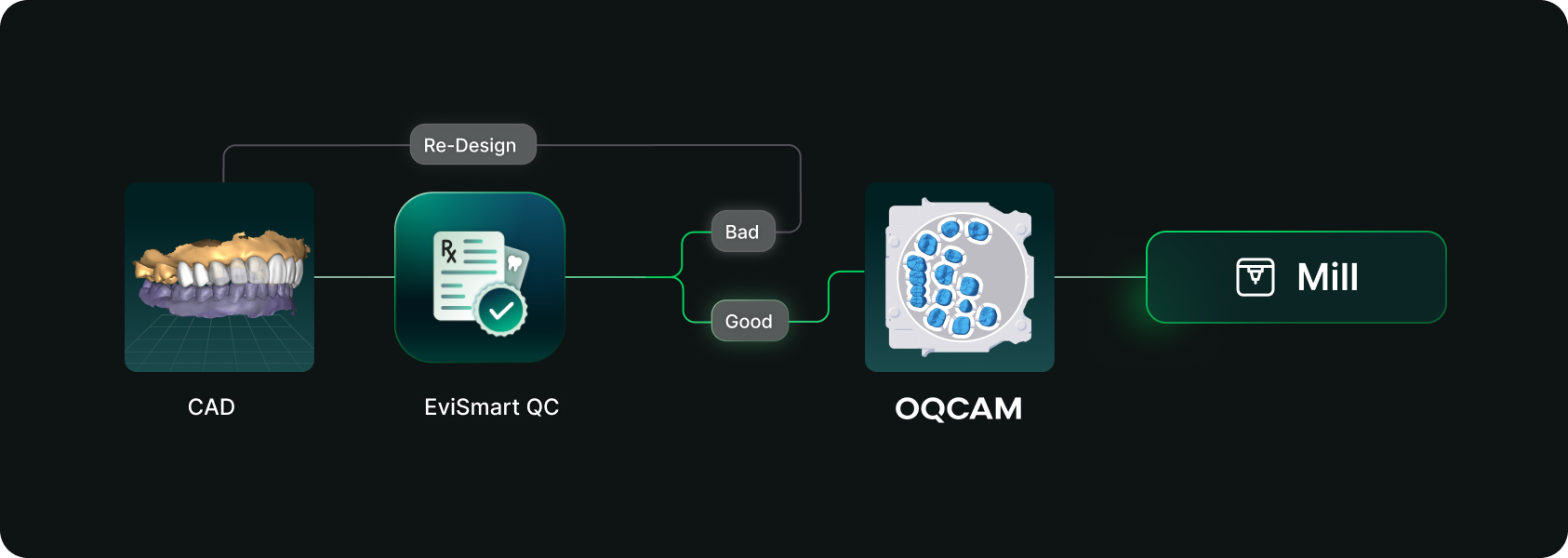
Designs you order from EviSmart arrive in your Oqcam already formatted. Named the way your nesting rules expect, with shade and material attached, and pointed at the machine that case belongs on.
The routing is decided per case. An implant case sends the crown to the mill and puck you cut implant crowns on, and the model to the printer you print models on. Different case types, different machines, chosen automatically rather than by a tech working through a dropdown for every file.
The trigger is QC approval. EviSmart designs your cases your way. The same team works on all your cases and learns what a good case looks like to you. Once your case passes our QC, it triggers a greenlight to send the design directly into your Oqcam account in under a minute.
Once the file arrives in your Oqcam, all your CAD/CAM technicians can review the nested design before starting the mill. That final QC step does not change and is not meant to.
Setup is one session. We connect your Oqcam account and agree where each of your products should go, using the routes and materials you have already built there. Nothing new to create, and you only revisit it if something changes.
Automatic sending only works if you trust what is being sent. Once a case is nested it gets cut, and a design that was not right is wasted material.
You choose what flows. During setup we map only the case types you want moving on their own. Anything unmapped never sends. It waits for you exactly as it does today.
Most labs start narrow. Bread and butter work first, night guards and posterior single units, then widen once they have watched it run for a few weeks. The lab that has been live longest started exactly there and has added case types since.
Your approval stays. This removes the file shuffling between design and CAM. It does not remove your eyes from the build.
For labs outsourcing design work the math gets compelling somewhere north of 30 cases a day into nesting, because that is where the handoff stops being an annoyance and starts being a role.
Not touchless design. Touchless handoff. Every step in that chain that requires judgment should keep requiring judgment, and every step that never did should stop requiring a person.
Nesting requires judgment. Confirming a build requires judgment. Renaming a file so software can read it does not, and never did. It was a workaround that quietly became somebody's job.
Nobody pays you to rename files.




