

While dentists have mastered their craft, running a thriving dental practice extends beyond clinical skills. It is, after all, a business.
The best CEOs don’t just focus on their products and services. They build high-performing teams, prioritize customer experience, track key metrics, and leverage technology to stay ahead.
As a dentist, adopting this mindset can help you scale your practice, increase profitability, and create a thriving work environment.
Here’s how to run your dental practice like a CEO:
“Customers will never love a company until the employees love it first.” – Simon Sinek, Leadership Expert
Your practice is only as strong as your team. From front-desk staff to hygienists and assistants, every member plays a role in shaping patient experience. If your team feels valued and motivated, they’ll go the extra mile for patients.
💡 CEO Mindset: Take inspiration from Howard Schultz, former Starbucks CEO, who invested in employee well-being because he knew happy employees create happy customers.
🏆 Tips:
"Your most unhappy customers are your greatest source of learning." – Bill Gates, Co-founder of Microsoft
Many dental practices lose patients due to unclear communication, long wait times, or an impersonal experience. Patients want to feel heard, understood, and valued.
💡 CEO Mindset: Think like Steve Jobs, who obsessed over Apple’s user experience. Every step of the patient journey, from booking an appointment to post-visit follow-ups, should be seamless.
🏆 Tips:
"If you can’t measure it, you can’t improve it." – Peter Drucker, Management Consultant
Total revenue is not the only measure of a practice’s success. Just like clinical diagnostics, business decisions should be based on measurable data. Knowing what to track helps you figure out what exactly you need to improve to keep your practice profitable.
💡 CEO Mindset: Jeff Bezos built Amazon into a global powerhouse by being obsessively data-driven. Every decision, from product pricing to warehouse efficiency, was backed by analytics. Below are some metrics you can track and benchmarks with which to compare your numbers, according to the American Dental Association (ADA):
🏆 Tip:
Use a dental workflow solution to automatically track important metrics. EviSmart, for example, has performance tracking features that monitor chair time utilization, patient acquisition and retention, remakes, collections and claims, and more. This is useful so you don’t have to spend time collating data manually.
"The most successful businesses are the ones that adapt to change, not the ones that resist it." – Satya Nadella, CEO of Microsoft
All great dentists dream of growth, but sustaining that growth is a different beast altogether. An expanding practice requires additional support — and technology is among the most valuable and cost-effective resources for clinics that want to see more patients but are unable to hire more support staff immediately.
💡 CEO Mindset: Satya Nadella transformed Microsoft by shifting its focus from legacy software to cloud-based solutions, AI, and automation, making the company more agile and future-ready. Dentists should take a similar approach: investing in smart, scalable technology that simplifies operations rather than complicating them.
🏆 Tip:
Software can do more than emails and basic scheduling. There are many clinic management platforms like EviSmart, with front-desk solutions (smart appointment scheduling and insurance claims and collections); lab solutions (centralized case tracking and collaboration tools with labs); and chair-side solutions (treatment recommendations, IOS support, and virtual vase try-in).
“Your brand is what people say about you when you’re not in the room.” – Jeff Bezos, Founder of Amazon
Now more than ever, a practice’s online reputation matters as much as word of mouth. Patients research dentists before booking, and your searchability and online reviews can make or break their decision.
💡 CEO Mindset: Elon Musk built Tesla into a global brand not just through innovation, but through masterful online engagement. He understands that direct communication with customers, whether through X (formerly Twitter), viral marketing, or bold messaging, creates trust and loyalty.
🏆 Tips:
Beyond clinical excellence, running a thriving dental practice is about leadership, strategy, and smart decision-making. Take cues from some of the world’s most successful CEOs to create a patient-centered and profitable practice.
✅ Invest in your team.
✅ Prioritize patient experience.
✅ Track financial performance.
✅ Leverage technology.
✅ Build your brand.
Your patients deserve the best, and so does your business. Lead with confidence, think like a CEO, and watch your practice grow.
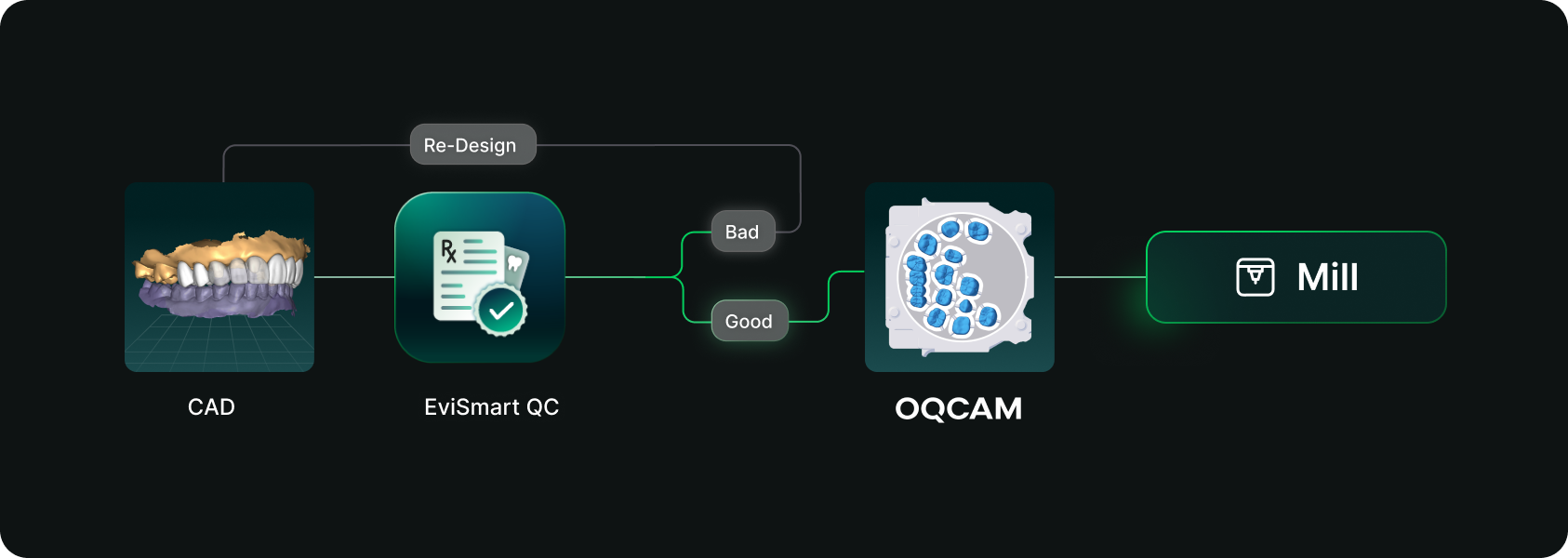
Designs you order from EviSmart arrive in your Oqcam already formatted. Named the way your nesting rules expect, with shade and material attached, and pointed at the machine that case belongs on.
The routing is decided per case. An implant case sends the crown to the mill and puck you cut implant crowns on, and the model to the printer you print models on. Different case types, different machines, chosen automatically rather than by a tech working through a dropdown for every file.
The trigger is QC approval. EviSmart designs your cases your way. The same team works on all your cases and learns what a good case looks like to you. Once your case passes our QC, it triggers a greenlight to send the design directly into your Oqcam account in under a minute.
Once the file arrives in your Oqcam, all your CAD/CAM technicians can review the nested design before starting the mill. That final QC step does not change and is not meant to.
Setup is one session. We connect your Oqcam account and agree where each of your products should go, using the routes and materials you have already built there. Nothing new to create, and you only revisit it if something changes.
Automatic sending only works if you trust what is being sent. Once a case is nested it gets cut, and a design that was not right is wasted material.
You choose what flows. During setup we map only the case types you want moving on their own. Anything unmapped never sends. It waits for you exactly as it does today.
Most labs start narrow. Bread and butter work first, night guards and posterior single units, then widen once they have watched it run for a few weeks. The lab that has been live longest started exactly there and has added case types since.
Your approval stays. This removes the file shuffling between design and CAM. It does not remove your eyes from the build.
For labs outsourcing design work the math gets compelling somewhere north of 30 cases a day into nesting, because that is where the handoff stops being an annoyance and starts being a role.
Not touchless design. Touchless handoff. Every step in that chain that requires judgment should keep requiring judgment, and every step that never did should stop requiring a person.
Nesting requires judgment. Confirming a build requires judgment. Renaming a file so software can read it does not, and never did. It was a workaround that quietly became somebody's job.
Nobody pays you to rename files.


