

Dentistry is changing but not in a way most labs were built for.
If your lab has felt more price pressure, more remakes/revisions, and less loyalty, you’re not imagining it. The market really has changed.
This report breaks down the biggest structural shift in the U.S. dentist workforce in decades and what it means for dental labs from 2025–2030.
According to ADA workforce data referenced in the report, the dentist population is becoming younger, more female, and more “system-driven” with earlier-career dentists far less likely to own practices.
Why labs feel this immediately: younger dentists expect systems, not favors. They communicate differently, decide differently, and have less tolerance for back-and-forth.
A few markers called out in the report:
The message for labs is not cultural, it’s operational: if you assume one communication style or one definition of “value,” you’ll be misaligned with a growing share of the market.
The report highlights a structural shift in how dentists work and buy:
Translation: relationship selling still matters, but decision-making is more fragmented and less personal than it used to be.
The report calls out the economic drivers behind “difficult” behavior:
That’s why case update chaos, unclear expectations, and admin-heavy workflows now translate into churn faster than ever.
The report contrasts “labs that struggle” vs. “labs that win.” Winning labs don’t just sell craftsmanship—they reduce dentists’ mental load, support early-career clinicians, communicate value (not just quality), and build systems alongside skill.
It’s not about becoming less artisanal. It’s about becoming more relevant.
This blog is a high-level summary. The full PDF includes the detailed workforce shifts, what they change about buying behavior, and the adaptation playbook for labs serving younger dentists, group practices, and DSOs through 2030.
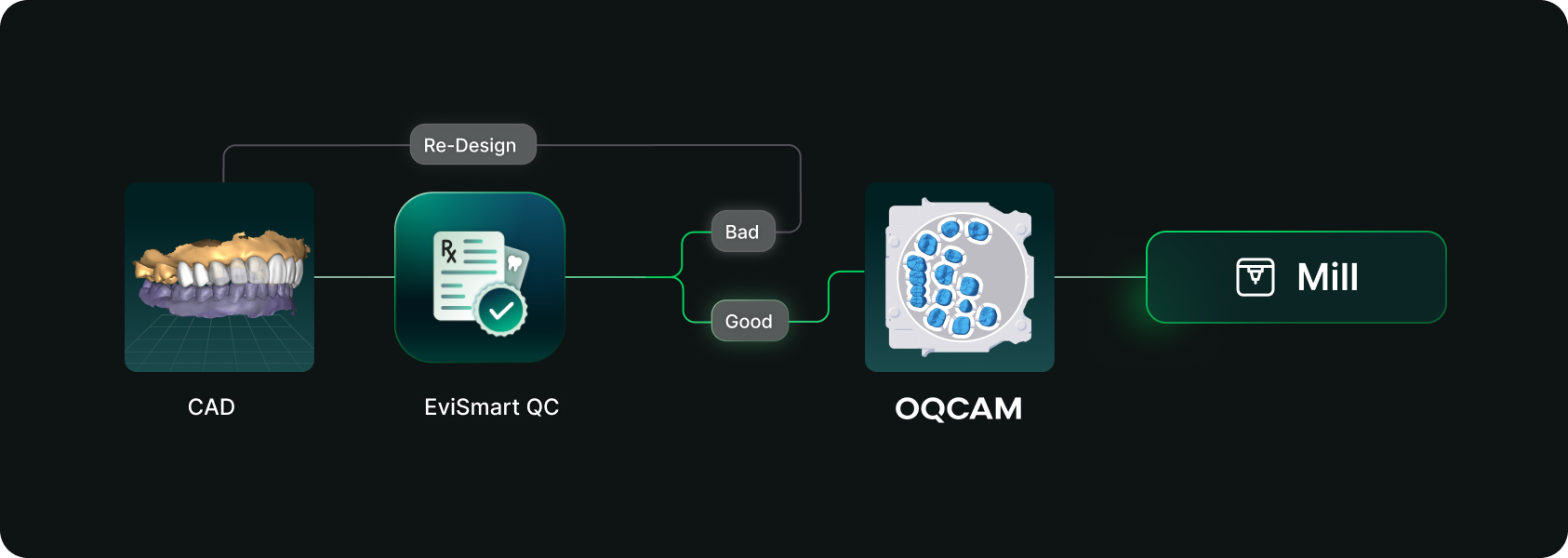
Designs you order from EviSmart arrive in your Oqcam already formatted. Named the way your nesting rules expect, with shade and material attached, and pointed at the machine that case belongs on.
The routing is decided per case. An implant case sends the crown to the mill and puck you cut implant crowns on, and the model to the printer you print models on. Different case types, different machines, chosen automatically rather than by a tech working through a dropdown for every file.
The trigger is QC approval. EviSmart designs your cases your way. The same team works on all your cases and learns what a good case looks like to you. Once your case passes our QC, it triggers a greenlight to send the design directly into your Oqcam account in under a minute.
Once the file arrives in your Oqcam, all your CAD/CAM technicians can review the nested design before starting the mill. That final QC step does not change and is not meant to.
Setup is one session. We connect your Oqcam account and agree where each of your products should go, using the routes and materials you have already built there. Nothing new to create, and you only revisit it if something changes.
Automatic sending only works if you trust what is being sent. Once a case is nested it gets cut, and a design that was not right is wasted material.
You choose what flows. During setup we map only the case types you want moving on their own. Anything unmapped never sends. It waits for you exactly as it does today.
Most labs start narrow. Bread and butter work first, night guards and posterior single units, then widen once they have watched it run for a few weeks. The lab that has been live longest started exactly there and has added case types since.
Your approval stays. This removes the file shuffling between design and CAM. It does not remove your eyes from the build.
For labs outsourcing design work the math gets compelling somewhere north of 30 cases a day into nesting, because that is where the handoff stops being an annoyance and starts being a role.
Not touchless design. Touchless handoff. Every step in that chain that requires judgment should keep requiring judgment, and every step that never did should stop requiring a person.
Nesting requires judgment. Confirming a build requires judgment. Renaming a file so software can read it does not, and never did. It was a workaround that quietly became somebody's job.
Nobody pays you to rename files.




