
A competing lab calls your dentist with an offer: same crown, $12 less per unit.
Your dentist calls you.
This is the moment that defines labs. And most labs get it wrong.
According to ADA survey research on why dentists switch labs, pricing ranked fifth and sixth on the list.
The top two reasons dentists leave, by a wide margin, were inconsistent quality and poor communication. Combined, those two factors account for more switching decisions than every other factor on the list combined. Including lower fees at another lab.
So when a dentist calls about a competitor's price, they are not really asking about price. They are signaling that something in the relationship is not working. That ordering from you feels harder than it should. That they are not sure their case got picked up. That the last rescan request took three days to resolve.
The price complaint is the symptom. The experience is the disease.
The instinct is to negotiate. Match the price, keep the account, move on.
But reducing price to retain an account does not resolve the underlying tension. It postpones it.
Dentists who choose labs based on price stay for price. And the first time a case is late, or a rescan request is slow, or a call goes unreturned, they revisit the conversation. Every competitor who undercuts you, even slightly, reopens it.
The $12 concession that feels manageable on one crown becomes $18,000 per year in lost revenue for a lab processing 1,500 crowns monthly, before accounting for the margin compression effect.
There is a category of dental lab that dentists describe in a specific way.
They do not say the lab is cheap. They do not even say the quality is the best in the market.
They say: "Ordering from them is just easy."
They say: "I never have to think about it."
That description, frictionless, predictable, proactive, is worth more in dentist retention than any discount a competing lab can offer.
The whitepaper breaks down exactly what those labs have built: the specific friction points that are quietly driving dentists toward the price conversation in the first place, what the ordering experience looks like from the dentist's chair without a lab that has invested in fixing it, and the one competitive advantage cheaper labs genuinely cannot copy.
It also includes a seven-day action list. Not a 90-day transformation program. Seven specific things any lab can implement this week, without new software or new hires, that begin shifting the dentist experience immediately.
The cheapest lab in your market is not your most dangerous competitor.
Your most dangerous competitor is the lab that makes ordering feel effortless, because that is the lab dentists will not leave for any price.
The whitepaper is for lab owners who are ready to stop competing on price and start competing on the one thing cheaper labs can never copy.
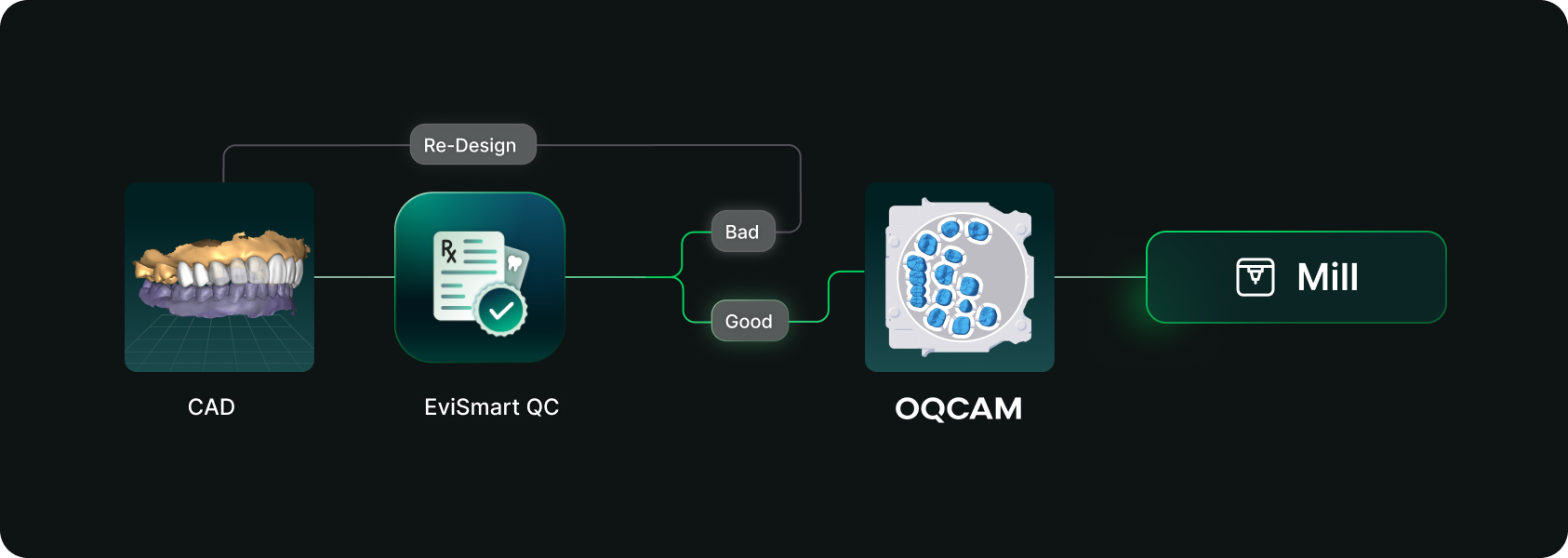
Designs you order from EviSmart arrive in your Oqcam already formatted. Named the way your nesting rules expect, with shade and material attached, and pointed at the machine that case belongs on.
The routing is decided per case. An implant case sends the crown to the mill and puck you cut implant crowns on, and the model to the printer you print models on. Different case types, different machines, chosen automatically rather than by a tech working through a dropdown for every file.
The trigger is QC approval. EviSmart designs your cases your way. The same team works on all your cases and learns what a good case looks like to you. Once your case passes our QC, it triggers a greenlight to send the design directly into your Oqcam account in under a minute.
Once the file arrives in your Oqcam, all your CAD/CAM technicians can review the nested design before starting the mill. That final QC step does not change and is not meant to.
Setup is one session. We connect your Oqcam account and agree where each of your products should go, using the routes and materials you have already built there. Nothing new to create, and you only revisit it if something changes.
Automatic sending only works if you trust what is being sent. Once a case is nested it gets cut, and a design that was not right is wasted material.
You choose what flows. During setup we map only the case types you want moving on their own. Anything unmapped never sends. It waits for you exactly as it does today.
Most labs start narrow. Bread and butter work first, night guards and posterior single units, then widen once they have watched it run for a few weeks. The lab that has been live longest started exactly there and has added case types since.
Your approval stays. This removes the file shuffling between design and CAM. It does not remove your eyes from the build.
For labs outsourcing design work the math gets compelling somewhere north of 30 cases a day into nesting, because that is where the handoff stops being an annoyance and starts being a role.
Not touchless design. Touchless handoff. Every step in that chain that requires judgment should keep requiring judgment, and every step that never did should stop requiring a person.
Nesting requires judgment. Confirming a build requires judgment. Renaming a file so software can read it does not, and never did. It was a workaround that quietly became somebody's job.
Nobody pays you to rename files.




