

The dental laboratory sector, a fragmented market ripe for consolidation, presents a compelling roll-up opportunity for private equity firms. The investment thesis is straightforward: acquire smaller, independent labs, streamline operations, and leverage economies of scale to build a high-value, market-leading enterprise. However, this thesis is critically flawed when it collides with two unassailable realities: the finite PE investment lifecycle and the deep-seated operational dysfunction endemic to the dental lab industry.
Private equity operates on a clock. With a typical holding period of five to seven years, value creation must be swift and decisive. The challenge is that understanding the unique complexities of the dental lab industry—from its technological fragmentation to its crippling reliance on key personnel—can consume two to three years of that precious timeline. This "learning curve tax" leaves a dangerously narrow window to execute a turnaround and achieve a premium exit.
This white paper dissects this critical timing conflict. It provides a quantitative analysis of the hidden costs and unpriced risks that erode value in a lab portfolio, including the financial toxicity of case remakes, the high cost of technician burnout, and the massive valuation discounts associated with key person dependency.
Crucially, it presents a strategic playbook to bypass the learning curve and accelerate the value creation timeline. The solution is not a disruptive "rip and replace" strategy, but the deployment of a universal, AI-powered automation platform. EviSmart was built on years of deep industry learning, enabling PE firms to implement an expert-level operational strategy from Day One. This allows consolidators to de-risk acquisitions, drive immediate operational efficiencies, and transform a collection of fragmented labs into a scalable, high-value platform well within the confines of the investment lifecycle.
The standard private equity value creation model is predicated on a well-defined, yet unforgiving, timeline. A fund's lifecycle, typically spanning ten years, allocates a holding period of roughly five to seven years for each portfolio company. Within this window, the mandate is clear: invest, optimize, and exit at a significant multiple. However, when entering a highly specialized and operationally complex sector like dental laboratories, PE firms face a significant, often underestimated, challenge: the "learning curve tax."
It can take a new ownership group two to three years just to fully comprehend the intricate web of issues plaguing the average dental lab. This includes understanding the nuances of different CAD/CAM systems, the causes of high remake rates, the drivers of technician burnout, and the unwritten rules that govern relationships with dental clients. This extended learning period directly conflicts with the PE timeline, compressing the effective window for value creation from 5-7 years down to a mere 2-4 years.
This time compression places immense pressure on the post-acquisition 100-day plan and makes traditional, sequential operational improvements untenable. The core strategic question for any dental lab consolidator becomes:
How can we execute a successful roll-up and achieve a premium exit when a significant portion of our limited timeline is consumed by simply learning the business's unique operational pitfalls? The answer is that you cannot afford to learn on the job. You must acquire and implement deep industry expertise from the moment the deal closes.
During due diligence, financial and tax risks are meticulously quantified. However, in the dental lab space, the most dangerous liabilities are operational and often go unpriced until they begin to actively destroy value post-acquisition.
The most significant unpriced risk in a lab acquisition is Key Person Dependency—the operational and financial reliance on a small number of individuals. A 2023 SHRM study found that 72% of companies have at least one employee whose departure would significantly disrupt operations. In dental labs, this figure is arguably higher. This "hero" technician is a human bottleneck, a single point of failure whose sudden absence due to sickness, burnout, or resignation can halt production.
This risk is magnified by the industry's workforce crisis. Dental technicians report extreme levels of burnout (95.5%) and high turnover intentions (32.9% intend to leave their organization). When these key employees leave, the cost to replace them can be 100-300% of their salary, and the loss of their undocumented knowledge is immeasurable. For an investor, this is a ticking time bomb. At exit, sophisticated buyers will heavily discount the value of a business built on such a fragile foundation, with the key person discount potentially eliminating up to 100% of the company's intangible value.
The second major risk is the chaos of integrating disparate systems and cultures. Each acquired lab comes with its own unique mix of software (Dentrix, EagleSoft, etc.), scanners, and milling machines. Attempting to force a uniform system via a "rip and replace" strategy is not only prohibitively expensive and time-consuming—a non-starter in a tight PE timeline—but also culturally toxic, often leading to the departure of the very teams you acquired. Without a viable integration strategy, the portfolio remains a collection of siloed entities, unable to share data, standardize quality, or achieve the economies of scale promised in the investment thesis.
The operational friction inherited with each acquisition creates a slow but continuous financial bleed. This value leakage manifests in several ways, each with a quantifiable impact on EBITDA.
Case remakes are the most visible symptom of a broken workflow. The national average for traditional dental lab remakes is 4%, with some labs reporting rates as high as 7%. While a "free" remake for the client may seem like good customer service, it is a financially toxic event for the lab and a direct hit to the portfolio's profitability.
The true cost of a single remake is often drastically underestimated:

The root cause of most remakes is poor communication. Studies reveal that dental technicians are forced to call the dentist for clarification on up to 66% of cases due to incomplete or unclear prescriptions, and a staggering 80% of prescription forms are legally incomplete. This constant back-and-forth is a "communication tax" that delays turnaround times (TAT).
Slow and unpredictable TATs directly erode client trust. For a dental practice, predictable scheduling is paramount to patient satisfaction and retention. When a lab's inefficiency forces a dentist to reschedule appointments, it jeopardizes the dentist's own client relationships. Given that retaining an existing patient is up to five times more cost-effective than acquiring a new one, dentists will not hesitate to switch to a more reliable lab partner, leading to client churn within the portfolio.
To stop the value leakage and unlock the true potential of a lab portfolio within the PE lifecycle, consolidators must move beyond the acquisition phase and implement a robust, immediate integration strategy. The solution is not to force every lab onto a single, rigid system. The solution is to deploy a universal, AI-powered automation platform that sits on top of existing infrastructure, connecting disparate systems and standardizing critical workflows across the entire network from Day One.
EviSmart is the only platform on the market designed to function as this universal operating layer. It was built on years of accumulated industry knowledge, providing an out-of-the-box solution that allows PE firms to bypass the costly "learning curve tax."
EviSmart provides the operational playbook that makes a consolidation strategy work within a compressed timeline.
The success of a dental laboratory roll-up is not determined at the deal table, but in the speed and efficacy of its post-acquisition integration. The traditional PE playbook, which allows for a multi-year learning curve, is incompatible with the deep-seated operational challenges and compressed timelines of the dental lab industry. A strategy built on simply acquiring assets without a plan to immediately unify their operations is destined to underperform, trapped by the compounding weight of inefficiency, risk, and value leakage.
The key to unlocking value is to deploy a standardized, scalable operational playbook that transforms a fragmented portfolio into a cohesive, high-performing, and profitable platform from Day One. EviSmart provides that playbook. By leveraging a platform built on years of industry expertise, PE firms can bypass the learning curve, de-risk their investment, and accelerate the value creation process, ensuring the creation of a truly scalable, high-value asset ready for a premium exit well within the fund's lifecycle.
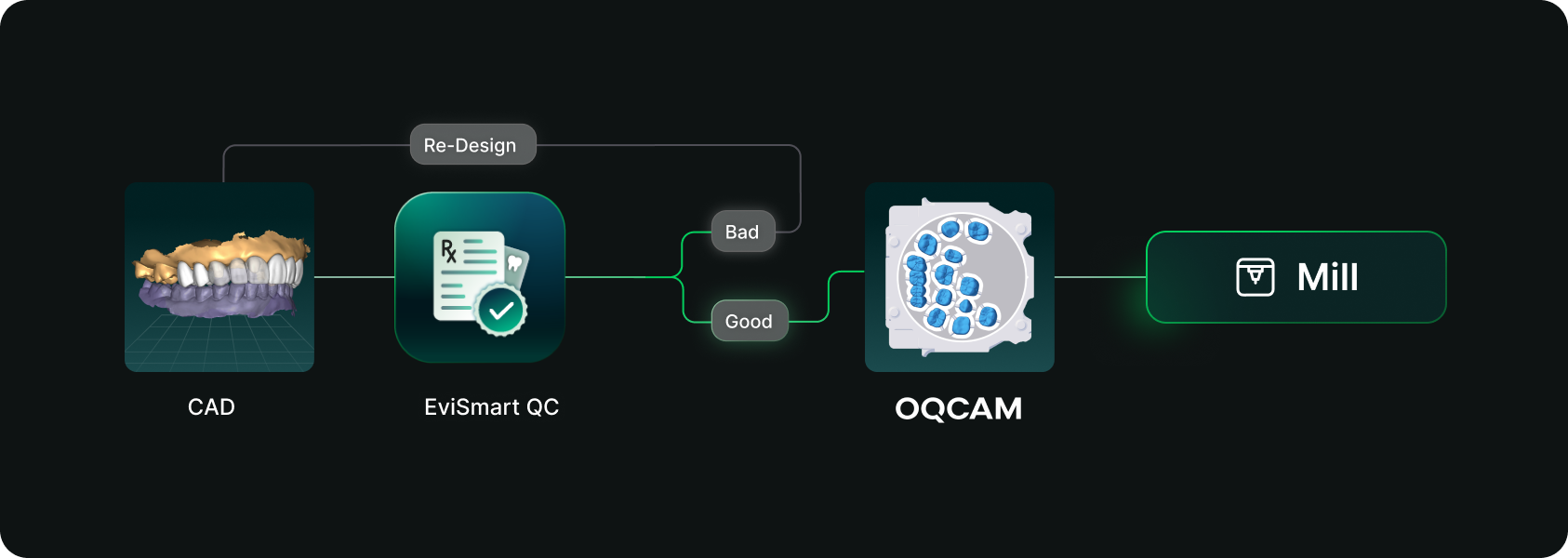
Designs you order from EviSmart arrive in your Oqcam already formatted. Named the way your nesting rules expect, with shade and material attached, and pointed at the machine that case belongs on.
The routing is decided per case. An implant case sends the crown to the mill and puck you cut implant crowns on, and the model to the printer you print models on. Different case types, different machines, chosen automatically rather than by a tech working through a dropdown for every file.
The trigger is QC approval. EviSmart designs your cases your way. The same team works on all your cases and learns what a good case looks like to you. Once your case passes our QC, it triggers a greenlight to send the design directly into your Oqcam account in under a minute.
Once the file arrives in your Oqcam, all your CAD/CAM technicians can review the nested design before starting the mill. That final QC step does not change and is not meant to.
Setup is one session. We connect your Oqcam account and agree where each of your products should go, using the routes and materials you have already built there. Nothing new to create, and you only revisit it if something changes.
Automatic sending only works if you trust what is being sent. Once a case is nested it gets cut, and a design that was not right is wasted material.
You choose what flows. During setup we map only the case types you want moving on their own. Anything unmapped never sends. It waits for you exactly as it does today.
Most labs start narrow. Bread and butter work first, night guards and posterior single units, then widen once they have watched it run for a few weeks. The lab that has been live longest started exactly there and has added case types since.
Your approval stays. This removes the file shuffling between design and CAM. It does not remove your eyes from the build.
For labs outsourcing design work the math gets compelling somewhere north of 30 cases a day into nesting, because that is where the handoff stops being an annoyance and starts being a role.
Not touchless design. Touchless handoff. Every step in that chain that requires judgment should keep requiring judgment, and every step that never did should stop requiring a person.
Nesting requires judgment. Confirming a build requires judgment. Renaming a file so software can read it does not, and never did. It was a workaround that quietly became somebody's job.
Nobody pays you to rename files.


