

“The rate of progress is exponential right now on at least three key dimensions: the algorithms, the chips, and the data centers… We’re talking 10x improvement every two years. Not 20x in four — 100x.”
In short: AI is not just getting better — it’s compounding. Fast.
But the real breakthrough isn’t just raw power. It’s how workflows are being reimagined, connected, and automated end-to-end.
This is where the future is heading — and it’s why we believe the next category-defining companies will be the ones that intelligently connect workflows across people, tools, and systems.
Every region is accelerating — and each brings unique strengths:
The AI race is no longer East vs. West — it’s multi-polar. Compute, models, and data are being developed and deployed regionally — often faster than regulation can adapt.
All the compute in the world is useless if it’s trapped in silos.
The winners will be those who connect AI to real business outcomes by automating:
We’re already seeing this in sectors like:
This is the shift: from tools to systems, from point solutions to intelligent orchestration.
What’s coming isn’t just faster models — it’s million-fold leverage:
…connected into one intelligent operating layer
That’s not 40x. It’s a million X transformation in how value is created.
And that transformation will only be captured by those who understand how to design, automate, and intelligently connect workflows — across the org chart, across departments, and across entire ecosystems.
“People still don’t appreciate the impact of this because they don’t understand exponential progress.” – All-In Podcast
We do.
And we’re building for it.
The future of work won’t be a patchwork of disconnected tools. It will be one intelligently connected workflow — augmented by AI, optimized for speed, and built for scale.
Let’s stop talking about AI in isolation.
Let’s talk about Intelligently Connected Workflows — and why they’re the next value creator.
---
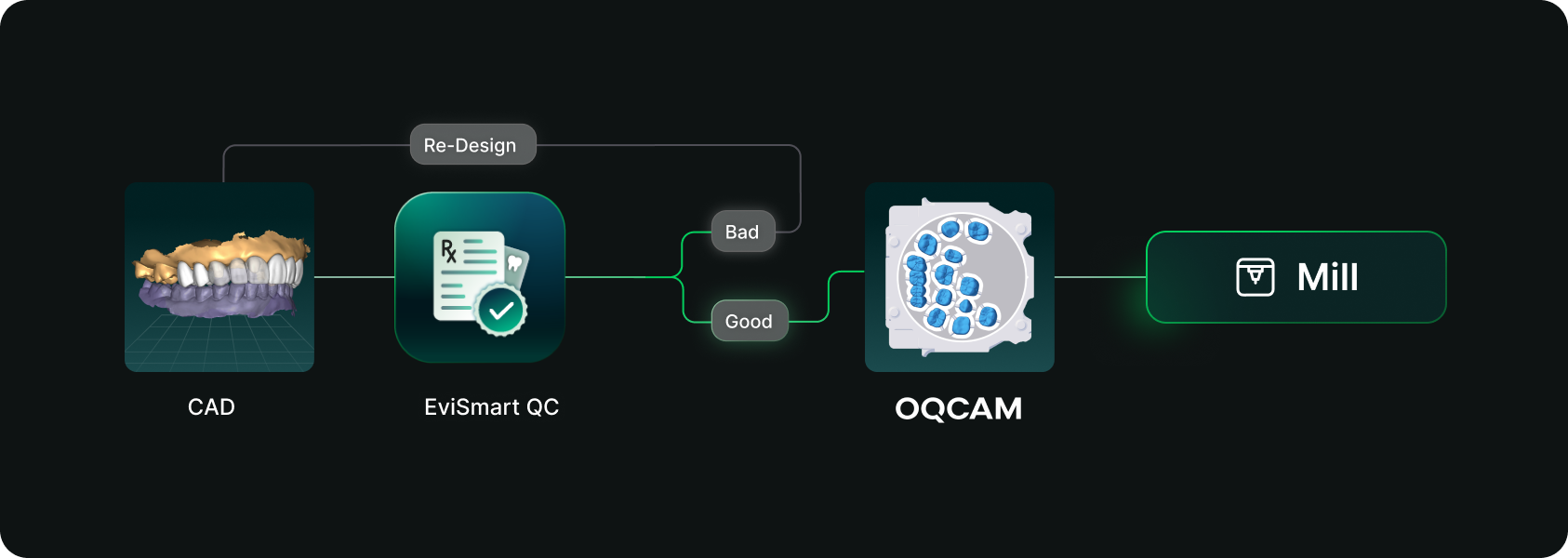
Designs you order from EviSmart arrive in your Oqcam already formatted. Named the way your nesting rules expect, with shade and material attached, and pointed at the machine that case belongs on.
The routing is decided per case. An implant case sends the crown to the mill and puck you cut implant crowns on, and the model to the printer you print models on. Different case types, different machines, chosen automatically rather than by a tech working through a dropdown for every file.
The trigger is QC approval. EviSmart designs your cases your way. The same team works on all your cases and learns what a good case looks like to you. Once your case passes our QC, it triggers a greenlight to send the design directly into your Oqcam account in under a minute.
Once the file arrives in your Oqcam, all your CAD/CAM technicians can review the nested design before starting the mill. That final QC step does not change and is not meant to.
Setup is one session. We connect your Oqcam account and agree where each of your products should go, using the routes and materials you have already built there. Nothing new to create, and you only revisit it if something changes.
Automatic sending only works if you trust what is being sent. Once a case is nested it gets cut, and a design that was not right is wasted material.
You choose what flows. During setup we map only the case types you want moving on their own. Anything unmapped never sends. It waits for you exactly as it does today.
Most labs start narrow. Bread and butter work first, night guards and posterior single units, then widen once they have watched it run for a few weeks. The lab that has been live longest started exactly there and has added case types since.
Your approval stays. This removes the file shuffling between design and CAM. It does not remove your eyes from the build.
For labs outsourcing design work the math gets compelling somewhere north of 30 cases a day into nesting, because that is where the handoff stops being an annoyance and starts being a role.
Not touchless design. Touchless handoff. Every step in that chain that requires judgment should keep requiring judgment, and every step that never did should stop requiring a person.
Nesting requires judgment. Confirming a build requires judgment. Renaming a file so software can read it does not, and never did. It was a workaround that quietly became somebody's job.
Nobody pays you to rename files.


