

Running a medium to large dental lab is a beast of a different kind. You're not just dealing with individual cases anymore; you're managing complex workflows, multiple technicians, demanding clients, and the ever-present pressure to stay profitable. Your financial health is under a microscope, and decisions carry significant weight.
You've likely already invested in digital technologies like CAD/CAM and 3D printing, and you're probably feeling the pinch of:
But it's not all doom and gloom. There's a huge opportunity for labs like yours to solidify your position, increase profitability, and become a true powerhouse in the industry. By addressing these challenges head-on, you can unlock significant financial upside.
You need a centralized system to manage your multi-faceted operation. This is not just about organizational tidiness; it's about financial control. Studies have shown that labs with centralized systems can see a 15-20% increase in overall efficiency, directly impacting profitability.
This means:
Automation isn't about replacing people; it's about empowering them to handle more complex, higher-value cases. For medium to large labs, the financial benefits of automation are substantial. Reports indicate that automation can lead to a 20-30% reduction in labor costs associated with routine tasks.
By automating repetitive tasks, you can:
You're sitting on a goldmine of data. The key is to extract meaningful insights that drive financial performance. By tracking and analyzing the right metrics, you can:
The dental industry is evolving rapidly, with increasing digitalization and consolidation. To not only survive but thrive, medium to large labs need to:
Platforms like EviSmart are designed to help labs like yours tackle these challenges and improve your financial performance. Here’s how EviSmart is making a difference for dental labs:
By implementing a solution like EviSmart that centralizes operations, automates workflows, and leverages AI for quality control and optimization, medium to large dental labs can expect a significant improvement in overall EBITDA.
Here's a conservative estimate:
Combining these factors, a medium to large dental lab can realistically expect an overall EBITDA improvement of 20-35% through the implementation of a comprehensive solution like EviSmart. This improvement will vary based on the lab's current efficiency and the extent of EviSmart implementation.
This translates to a substantial financial benefit, allowing you to reinvest in your business, expand your services, or increase profitability.
By embracing a digital-first approach and leveraging the right tools, you can transform your medium-to-large lab from a complex juggling act into a well-oiled, growth-oriented machine that delivers both exceptional dental solutions and strong financial results.
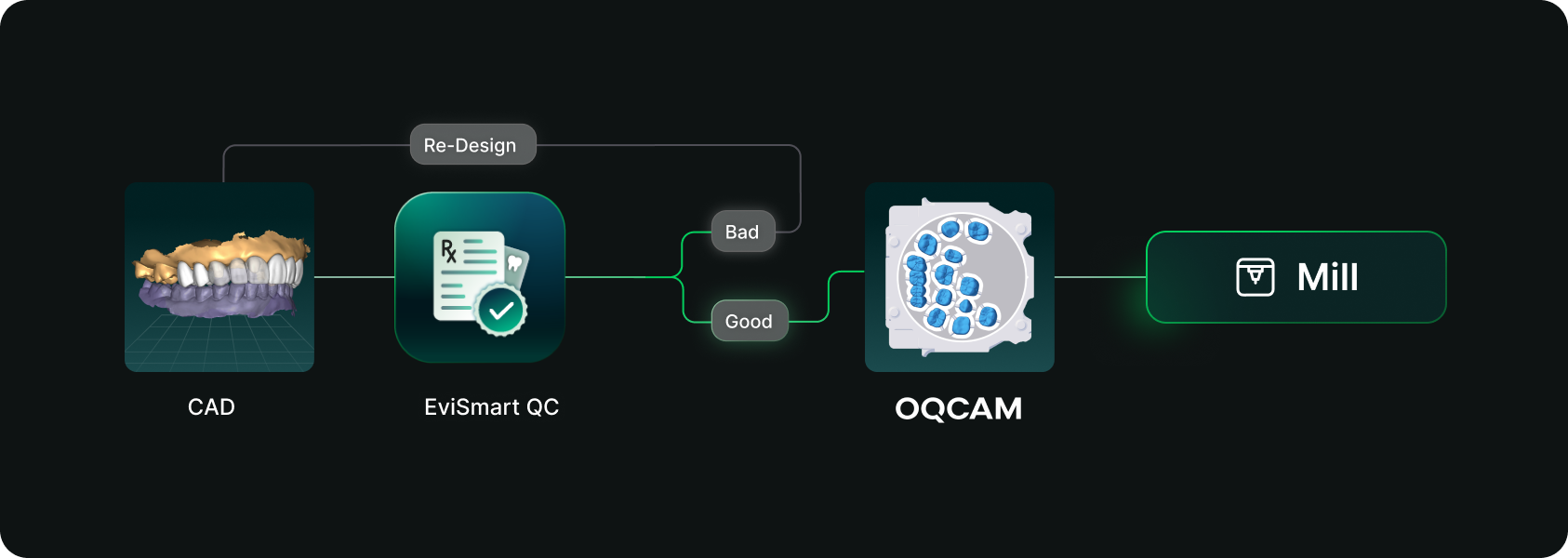
Designs you order from EviSmart arrive in your Oqcam already formatted. Named the way your nesting rules expect, with shade and material attached, and pointed at the machine that case belongs on.
The routing is decided per case. An implant case sends the crown to the mill and puck you cut implant crowns on, and the model to the printer you print models on. Different case types, different machines, chosen automatically rather than by a tech working through a dropdown for every file.
The trigger is QC approval. EviSmart designs your cases your way. The same team works on all your cases and learns what a good case looks like to you. Once your case passes our QC, it triggers a greenlight to send the design directly into your Oqcam account in under a minute.
Once the file arrives in your Oqcam, all your CAD/CAM technicians can review the nested design before starting the mill. That final QC step does not change and is not meant to.
Setup is one session. We connect your Oqcam account and agree where each of your products should go, using the routes and materials you have already built there. Nothing new to create, and you only revisit it if something changes.
Automatic sending only works if you trust what is being sent. Once a case is nested it gets cut, and a design that was not right is wasted material.
You choose what flows. During setup we map only the case types you want moving on their own. Anything unmapped never sends. It waits for you exactly as it does today.
Most labs start narrow. Bread and butter work first, night guards and posterior single units, then widen once they have watched it run for a few weeks. The lab that has been live longest started exactly there and has added case types since.
Your approval stays. This removes the file shuffling between design and CAM. It does not remove your eyes from the build.
For labs outsourcing design work the math gets compelling somewhere north of 30 cases a day into nesting, because that is where the handoff stops being an annoyance and starts being a role.
Not touchless design. Touchless handoff. Every step in that chain that requires judgment should keep requiring judgment, and every step that never did should stop requiring a person.
Nesting requires judgment. Confirming a build requires judgment. Renaming a file so software can read it does not, and never did. It was a workaround that quietly became somebody's job.
Nobody pays you to rename files.


