

Dentists are busier than ever, according to research by the American Dental Association (ADA). They have been working longer hours since the pandemic, while practice expenses balloon faster than revenues. With staffing shortages also prevalent, the ADA predicted a continued ‘margin compression’ in the dental sector.
Improving workflows is now even more crucial, as lost chair time and operational delays lead to the loss of already dwindling revenues.
Here’s how your dental practice can streamline processes for better productivity.
We list some workflow inefficiencies common in clinics, the ‘symptoms’ that signify if you’re experiencing them, and a solution you can implement to bust the bottleneck.
🔍 Symptom: High rates of last-minute cancellations and no-shows
Solutions:
🔍 Symptom: Frequently understaffed or overstaffed
Solutions:
🔍 Symptom: Patients frequently complain about difficulty booking appointments
Solutions:
🔍 Symptom: Certain treatments consistently take longer than expected
Solutions:
🔍 Symptom: Too much time is spent on non-billable tasks, like administrative tasks
Solutions:
🔍 Symptom: Restorations from labs take too long to arrive
Solutions:
🔍 Symptom: Frequent remakes are causing case delays
Solutions:
🔍 Symptom: Case acceptance rates are low
Solution:
🔍 Symptom: Payment processing takes too long
Solutions:
As dentists often advise patients, prevention is better than cure. Here are the top 3 challenges dentists predict they will face this 2025, according to the ADA — and how you can take action now before it affects your workflow (and revenue).
1️⃣ Staff Shortage. 3 in 5 dentists are worried about recruiting and retaining staff.
How to Get Ahead: Burnout is among the top contributors of employee turnover in the dental industry. Assess your clinic’s workload and how it is distributed among staff. If possible, reassign repetitive administrative tasks to non-clinical staff so the latter can focus on value-adding work. Better yet, consider automating these tasks with a digital workflow solution.
2️⃣ Insurance Frustrations. More than half of dentists surveyed by the ADA predicted issues with denied coverage, delayed payments, and other related issues.
How to Get Ahead: Implementing automated tools to speed up the claims submission process can reduce human error and the time it takes to process claims, further alleviating delays. It may also be helpful to offer in-house payment plans like credit card processing or utilizing third-party financing options to reduce the reliance on insurance payments.
3️⃣ Increasing Overhead. Nearly half of dentists cited overhead costs as a persisting concern this 2025.
How to get ahead: The ADA survey also revealed that 2 in 5 dentists plan to invest in new machines this year, while only 1 in 5 dentists plan to invest in new software. While these require upfront investment that not all clinics may have, these investments are cost-saving in the long run, especially if it speeds up your workflow and allows you to take on more patients.
EviSmart by Evident is a powerful dental workflow solution that leverages AI to automate your processes and elevate your practice.
It provides tools for growth like performance tracking and revenue management; front desk solutions like patient communication and scheduling; digital lab solutions like case tracking and outsourced CAD designs; and chairside solutions like automatic IOS QC and 3D case presentations.
We know every practice is different, so our team will build a custom dashboard to best fit your clinic’s needs. You get the solutions to your problems without all the noise or clutter.
Learn more about elevating patient care with EviSmart Clinic here.
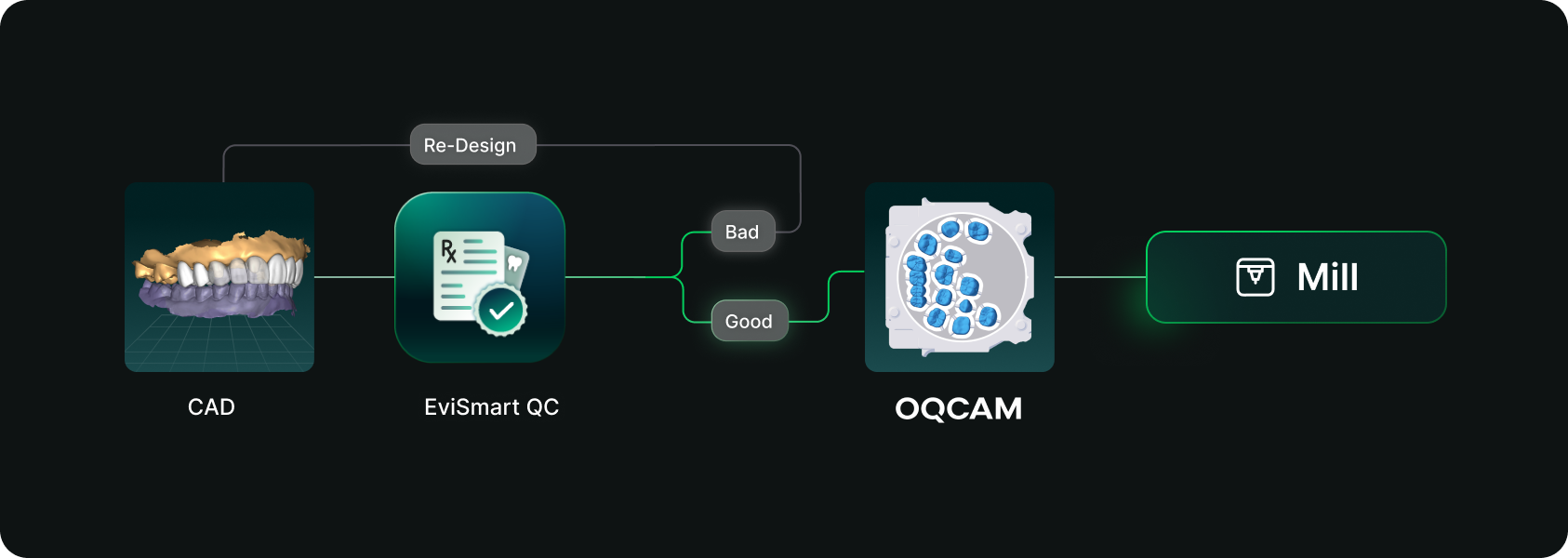
Designs you order from EviSmart arrive in your Oqcam already formatted. Named the way your nesting rules expect, with shade and material attached, and pointed at the machine that case belongs on.
The routing is decided per case. An implant case sends the crown to the mill and puck you cut implant crowns on, and the model to the printer you print models on. Different case types, different machines, chosen automatically rather than by a tech working through a dropdown for every file.
The trigger is QC approval. EviSmart designs your cases your way. The same team works on all your cases and learns what a good case looks like to you. Once your case passes our QC, it triggers a greenlight to send the design directly into your Oqcam account in under a minute.
Once the file arrives in your Oqcam, all your CAD/CAM technicians can review the nested design before starting the mill. That final QC step does not change and is not meant to.
Setup is one session. We connect your Oqcam account and agree where each of your products should go, using the routes and materials you have already built there. Nothing new to create, and you only revisit it if something changes.
Automatic sending only works if you trust what is being sent. Once a case is nested it gets cut, and a design that was not right is wasted material.
You choose what flows. During setup we map only the case types you want moving on their own. Anything unmapped never sends. It waits for you exactly as it does today.
Most labs start narrow. Bread and butter work first, night guards and posterior single units, then widen once they have watched it run for a few weeks. The lab that has been live longest started exactly there and has added case types since.
Your approval stays. This removes the file shuffling between design and CAM. It does not remove your eyes from the build.
For labs outsourcing design work the math gets compelling somewhere north of 30 cases a day into nesting, because that is where the handoff stops being an annoyance and starts being a role.
Not touchless design. Touchless handoff. Every step in that chain that requires judgment should keep requiring judgment, and every step that never did should stop requiring a person.
Nesting requires judgment. Confirming a build requires judgment. Renaming a file so software can read it does not, and never did. It was a workaround that quietly became somebody's job.
Nobody pays you to rename files.


