
You’ve posted the job ad and sorted through resumes. Now comes the tricky part: interviewing.
A strong interview process can be the difference between hiring a high-performing team member or dealing with turnover down the road.
This guide walks you through how to conduct effective interviews that lead to confident hiring decisions.
It’s common for dentists to Google “top 10 interview questions” before meeting with a potential hire — but it’s also common for candidates to research “top 10 interview answers.” This was the observation of Dental Practice Management Strategist Ginny Hegarty in the American Dental Association (ADA)’s podcast Dental Sound Bites.
Hegarty added, “This theater goes on where everybody’s doing their performance really well, but they’re not learning anything about each other."
As such, she recommended consulting with the rest of the team to create de facto criteria for a good hire. “Often, doctors think if it's going to get done, it's got to be me. But your team wants to be part of the process. And it will be more successful if they are,” Hegarty said. “People support what they help create.”
Hagerty advises clinics to identify what worked and what didn’t among previous hires. You don't have to name names or cite specific incidents, but it can be useful to pinpoint the team’s non-negotiables moving forward. Did someone bring many strengths to a position but was not providing detailed chart notes, which caused bottlenecks? Then good written and oral communication may be one of your non-negotiables.
Simply asking staff what they want to see in a new hire may not always yield the most substantial results, so one useful technique is reverse brainstorming. Instead of thinking of the best candidate, they think of the worst: maybe someone who’s always late, keeps crucial patient information to themselves, or uses too much jargon while speaking to patients.
Once you have this list, you reverse these ideas back into positive ones: someone who’s punctual, a team player who keeps charts updated, and a great communicator who laymanizes information for patients. This becomes what you look for in candidates.

Now that you have your team’s input, you can ask questions that help determine if a candidate possesses the traits you’re looking for. Below is a useful structure to follow so you hit all bases during the interview.
What do you ask after “Tell me about yourself”? Regardless of role, you can ask the following.
Especially for clinical roles, it’s best to ask specific questions to gauge a candidate’s knowledge. Below are sample questions for a dental assistant role and a dental hygienist role, as well as what to look for in their responses.
Dental assistant sample questions:
Dental hygienist sample questions:
Beyond their hard skills, you can ask these questions for any role to assess problem-solving and critical thinking.
The following questions help determine how a candidate can work with your current team and culture.
During the interview, you not only get to know the candidate; they get to know you and your clinic as well. Open the floor to questions about the role and its contributions to daily operations.

Score their responses during the interview
While we know what to look for in the candidate’s responses, how do we know which candidates are the best fit?
Hagerty, from the ADA podcast, has a scoring system for interviews:
Imagine a phone interview has 6 questions, and each question is worth 5 points. The interviewer can give them a score between 1 and 5, then total it after the conversation. Instead of taking down everything they say, note what you think of their answers.
Now, of a possible 30 points, Hagerty suggested setting a minimum score to filter candidates who would move on to the next phase. This can be 20-25 points.
Don’t be afraid to restart the search
The goal of recruitment, according to Hagerty, is not to hire the best among the applicants but to evaluate each of them against the role. That means it’s possible for none of the candidates to fit the bill.
Being short-staffed is admittedly challenging, but taking your time with recruitment and ensuring you’re getting the best possible fit is worth it in the long run. We’re trying to avoid a high turnover rate, which can lower overall employee morale.
By taking the time to define your hiring needs, ask intentional questions, and quantitatively assess candidates, you minimize costly hiring mistakes. Investing in the right people now will save you time, money, and stress in the future; and a strong team fosters a more efficient clinic, happier patients, and a fast-growing practice.
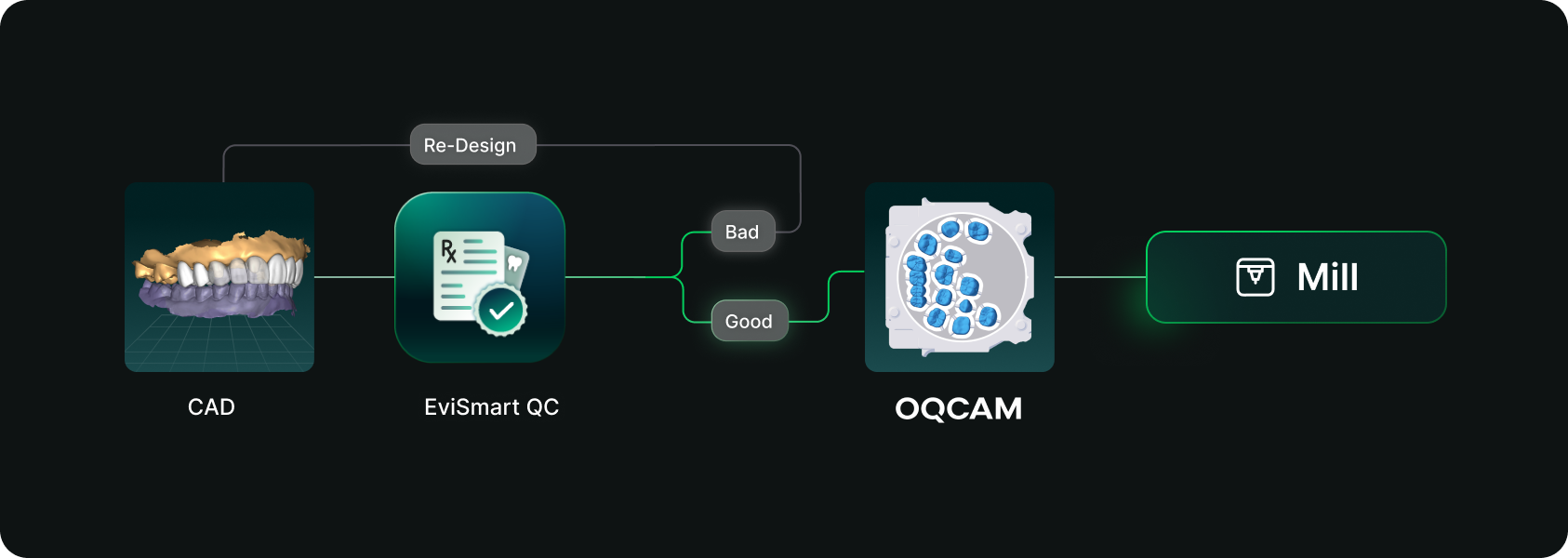
Designs you order from EviSmart arrive in your Oqcam already formatted. Named the way your nesting rules expect, with shade and material attached, and pointed at the machine that case belongs on.
The routing is decided per case. An implant case sends the crown to the mill and puck you cut implant crowns on, and the model to the printer you print models on. Different case types, different machines, chosen automatically rather than by a tech working through a dropdown for every file.
The trigger is QC approval. EviSmart designs your cases your way. The same team works on all your cases and learns what a good case looks like to you. Once your case passes our QC, it triggers a greenlight to send the design directly into your Oqcam account in under a minute.
Once the file arrives in your Oqcam, all your CAD/CAM technicians can review the nested design before starting the mill. That final QC step does not change and is not meant to.
Setup is one session. We connect your Oqcam account and agree where each of your products should go, using the routes and materials you have already built there. Nothing new to create, and you only revisit it if something changes.
Automatic sending only works if you trust what is being sent. Once a case is nested it gets cut, and a design that was not right is wasted material.
You choose what flows. During setup we map only the case types you want moving on their own. Anything unmapped never sends. It waits for you exactly as it does today.
Most labs start narrow. Bread and butter work first, night guards and posterior single units, then widen once they have watched it run for a few weeks. The lab that has been live longest started exactly there and has added case types since.
Your approval stays. This removes the file shuffling between design and CAM. It does not remove your eyes from the build.
For labs outsourcing design work the math gets compelling somewhere north of 30 cases a day into nesting, because that is where the handoff stops being an annoyance and starts being a role.
Not touchless design. Touchless handoff. Every step in that chain that requires judgment should keep requiring judgment, and every step that never did should stop requiring a person.
Nesting requires judgment. Confirming a build requires judgment. Renaming a file so software can read it does not, and never did. It was a workaround that quietly became somebody's job.
Nobody pays you to rename files.


