

Evident, a leader in digital dental solutions, today announced the launch of EviSmart QC, a revolutionary new tool within the EviSmart platform. EviSmart QC leverages advanced Ai technology to automatically review both prescriptions and digital impressions (scans) as they are received, ensuring that all data is complete and clear before reaching production. The tool flags issues such as missing margins, misaligned bites, and incomplete or unclear prescription information—helping dental labs improve accuracy, reduce rework, and eliminate costly production delays.
"Quality control is essential to efficient digital dentistry, and EviSmart QC offers a new way to ensure prescriptions and scans meet the necessary standards before they move to production," said Paolo Kalaw, CEO of Evident. "By automating this process, we’re helping labs reduce errors and improve the consistency of their workflows."
EviSmart QC performs intelligent, Ai-driven quality checks on each case, reviewing prescriptions and scans. It ensures that prescriptions are matched to the correct scan and flags incomplete or inconsistent information automatically. Additionally, the system identifies low-quality scans and incomplete prescriptions, escalating cases only when human review is necessary.
EviSmart QC uses criteria tailored to each customer’s specific preferences, meaning that every dental lab gets a unique Ai configuration that fits their needs.
Evident is committed to advancing digital dentistry by providing Ai-driven solutions that address the key challenges faced by dental labs, dentists, and manufacturers. The EviSmart platform, which includes EviSmart QC, EviSmart Nest, EviSmart Downloader, and other cutting-edge tools, is designed to streamline operations, improve accuracy, and enhance collaboration across the dental ecosystem. By optimizing workflows and improving the flow of data between providers, EviSmart helps deliver top-quality results efficiently and effectively.
EviSmart QC is now available as part of the EviSmart platform. For more information or to schedule a demo, click 'Contact us' in the menu above.
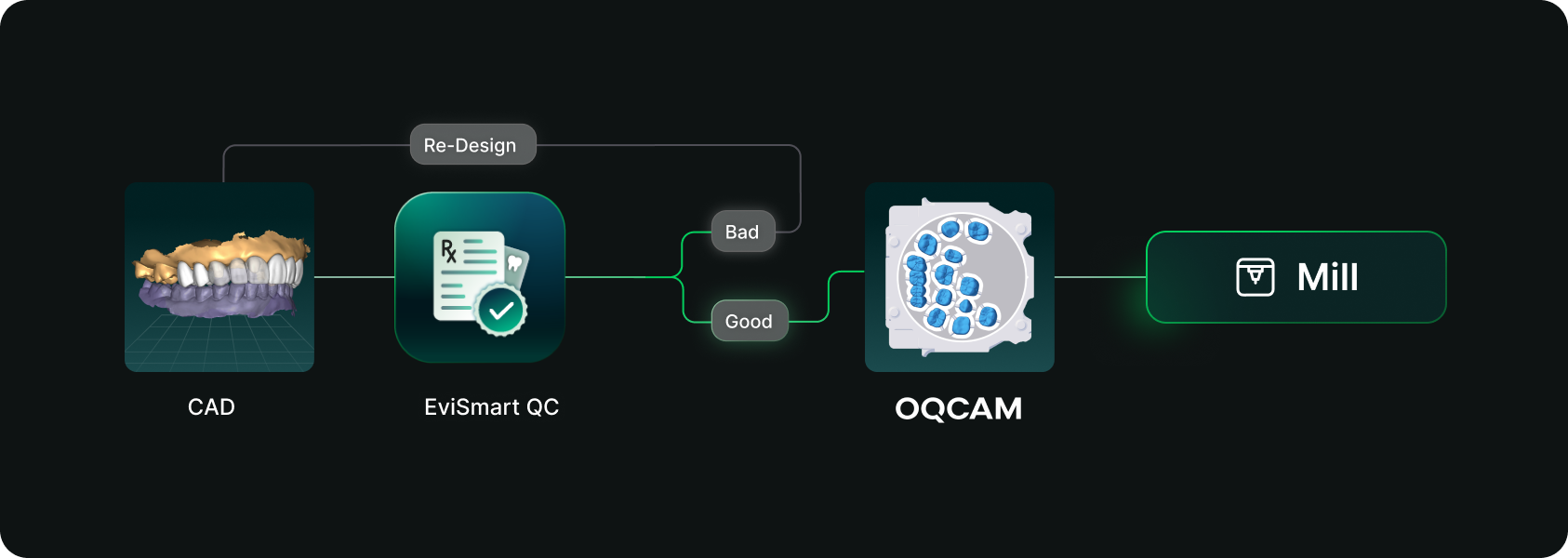
Designs you order from EviSmart arrive in your Oqcam already formatted. Named the way your nesting rules expect, with shade and material attached, and pointed at the machine that case belongs on.
The routing is decided per case. An implant case sends the crown to the mill and puck you cut implant crowns on, and the model to the printer you print models on. Different case types, different machines, chosen automatically rather than by a tech working through a dropdown for every file.
The trigger is QC approval. EviSmart designs your cases your way. The same team works on all your cases and learns what a good case looks like to you. Once your case passes our QC, it triggers a greenlight to send the design directly into your Oqcam account in under a minute.
Once the file arrives in your Oqcam, all your CAD/CAM technicians can review the nested design before starting the mill. That final QC step does not change and is not meant to.
Setup is one session. We connect your Oqcam account and agree where each of your products should go, using the routes and materials you have already built there. Nothing new to create, and you only revisit it if something changes.
Automatic sending only works if you trust what is being sent. Once a case is nested it gets cut, and a design that was not right is wasted material.
You choose what flows. During setup we map only the case types you want moving on their own. Anything unmapped never sends. It waits for you exactly as it does today.
Most labs start narrow. Bread and butter work first, night guards and posterior single units, then widen once they have watched it run for a few weeks. The lab that has been live longest started exactly there and has added case types since.
Your approval stays. This removes the file shuffling between design and CAM. It does not remove your eyes from the build.
For labs outsourcing design work the math gets compelling somewhere north of 30 cases a day into nesting, because that is where the handoff stops being an annoyance and starts being a role.
Not touchless design. Touchless handoff. Every step in that chain that requires judgment should keep requiring judgment, and every step that never did should stop requiring a person.
Nesting requires judgment. Confirming a build requires judgment. Renaming a file so software can read it does not, and never did. It was a workaround that quietly became somebody's job.
Nobody pays you to rename files.


