

If you run a dental lab, you’re feeling it:
higher costs, tight margins, and growing pressure from clinics and DSOs.
This isn’t your imagination — it’s a real pattern happening across medium to multi-site labs.
We call it The Margin Squeeze Multiplier, because it’s not caused by one thing. It’s caused by five forces working together.
This article breaks down:
Here are the five main reasons dental labs lose profit today:
Zirconia, discs, pucks, consumables — everything is more expensive.
Skilled techs are harder to find and more expensive to keep.
Bigger groups negotiate harder. Smaller clinics expect more “white glove” service for less.
Every remake you absorb doubles your labor + material cost for that case.
Cases coming from:
…creates search time, delays, missing info, and errors.
These five factors multiply each other — and that’s when margin collapses.
Every medium–multi-site lab experiences the same seasonal spike in stress:
When your team is already stretched thin, every small bottleneck becomes a crisis.
This is when the margin squeeze is most visible.
When margins shrink, labs often blame:
But these are external pressures you cannot control.
The labs that grow profitably focus on what they can control:
Reducing internal chaos.
Internal chaos is the multiplier. It’s what turns a small problem into a major profit leak.
Internal chaos amplifies every cost.
Here’s how:
A bad scan wastes your senior tech’s time — the most expensive time you have.
Missing Rxs and shade notes slow down production dramatically.
A lot of the day is spent downloading files, re-typing Rxs, or tracking down missing information. These repetitive tasks pull technicians away from the high-skill work that keeps cases moving and impacts overall efficiency.
You can’t manage what you can’t see.
And chaos makes everything invisible.
Every delay compounds.
Every delay costs money.
Every delay damages trust.
Chaos is the real margin killer — not materials or salaries.
Modern labs aren’t beating margin squeeze through discounts or overtime.
They’re doing it through workflow standardization and automation.
Here’s what they focus on:
Stop bad scans before they enter your workflow.
This reduces:
All cases and communication go through one channel.
This eliminates:
Top labs automate:
This frees up technicians for actual production, not admin tasks.
No more relying on hero technicians.
No more “only this person knows how to handle that dentist.”
Predictable workflows = predictable margin.
Modern labs track:
This lets them make smarter decisions about pricing and service level.
If you only read one thing, read this:
You can't control zirconia prices.
You can't control the labor market.
You CAN control internal chaos — and that’s where all your margin lives.
When you eliminate chaos:
This is how the most profitable labs protect themselves — especially during the holiday and sick-day season.
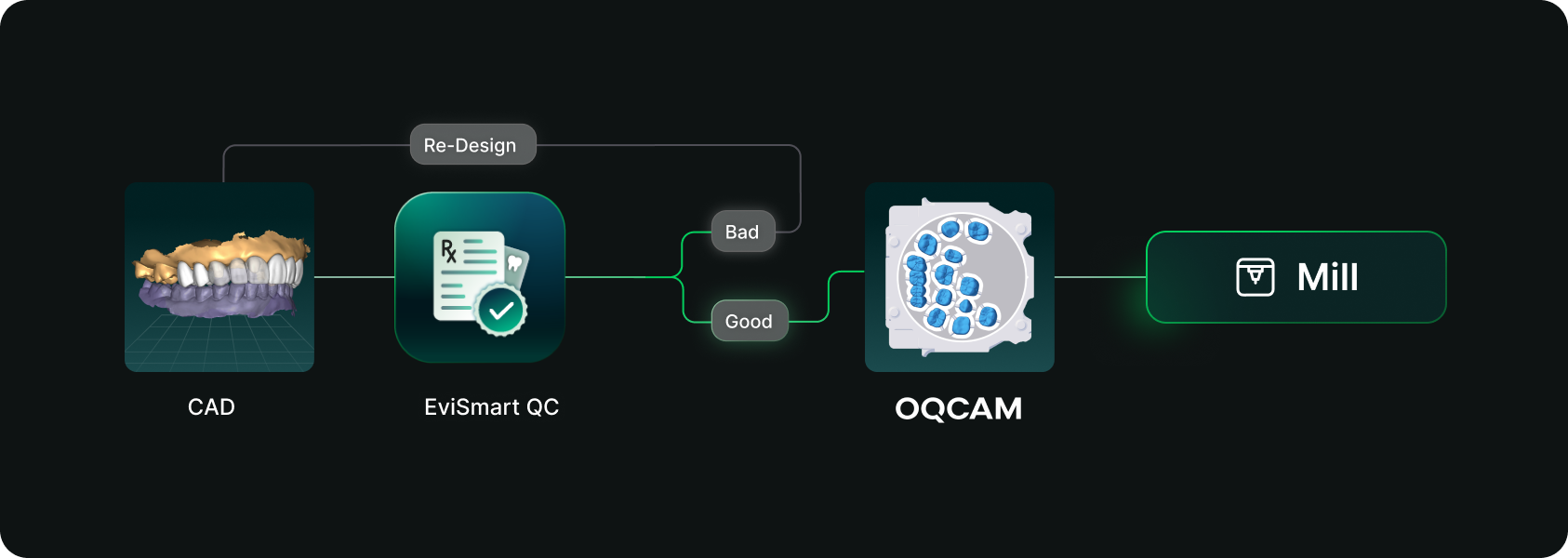
Designs you order from EviSmart arrive in your Oqcam already formatted. Named the way your nesting rules expect, with shade and material attached, and pointed at the machine that case belongs on.
The routing is decided per case. An implant case sends the crown to the mill and puck you cut implant crowns on, and the model to the printer you print models on. Different case types, different machines, chosen automatically rather than by a tech working through a dropdown for every file.
The trigger is QC approval. EviSmart designs your cases your way. The same team works on all your cases and learns what a good case looks like to you. Once your case passes our QC, it triggers a greenlight to send the design directly into your Oqcam account in under a minute.
Once the file arrives in your Oqcam, all your CAD/CAM technicians can review the nested design before starting the mill. That final QC step does not change and is not meant to.
Setup is one session. We connect your Oqcam account and agree where each of your products should go, using the routes and materials you have already built there. Nothing new to create, and you only revisit it if something changes.
Automatic sending only works if you trust what is being sent. Once a case is nested it gets cut, and a design that was not right is wasted material.
You choose what flows. During setup we map only the case types you want moving on their own. Anything unmapped never sends. It waits for you exactly as it does today.
Most labs start narrow. Bread and butter work first, night guards and posterior single units, then widen once they have watched it run for a few weeks. The lab that has been live longest started exactly there and has added case types since.
Your approval stays. This removes the file shuffling between design and CAM. It does not remove your eyes from the build.
For labs outsourcing design work the math gets compelling somewhere north of 30 cases a day into nesting, because that is where the handoff stops being an annoyance and starts being a role.
Not touchless design. Touchless handoff. Every step in that chain that requires judgment should keep requiring judgment, and every step that never did should stop requiring a person.
Nesting requires judgment. Confirming a build requires judgment. Renaming a file so software can read it does not, and never did. It was a workaround that quietly became somebody's job.
Nobody pays you to rename files.


