

Between March 2020 and April 2026, the dental lab industry absorbed four distinct crises back-to-back. A pandemic. A supply-chain and tariff era that quadrupled shipping costs and added 9–14% to the dental supply basket. An economic downturn that compressed margins while wages rose 20–30% in tight metros. And now a U.S.–Iran conflict that has driven Brent crude near $110 per barrel, container rates up 129%, and recession probability past 49% — with every leading indicator of dental volume already softening.
The defining feature of the last five years isn't any single one of those events. It's that each arrived before the previous had resolved. Lab owners haven't been recovering. They've been absorbing.
And yet, inside that same stretch, a specific group of labs has emerged stronger than they entered. Not by luck. Not by size. By making one consistent decision: leverage over labor.
Every previous downturn in the industry's history had at least one pressure moving in labs' favor. In 2020, PPP cash moved through. In 2021–22, case volume rebounded faster than anyone expected. In 2022–23, revenue grew nominally even as margins compressed. In 2024, strong labs could still reprice.
2025–2026 is the first moment in this stretch where cost is up, supply pressure is up, demand is softening, and the technician pipeline has structurally collapsed — simultaneously. Germany has 7,000+ unfilled dental technician positions. North American training programs graduate roughly 300 technicians per year against 7,700 annual openings. 49% of lab professionals are planning to retire within five years.
You cannot hire your way out of this one. The technicians don't exist.
After 30+ interviews with lab owners across the US, UK, Netherlands, Germany, Australia, and beyond, one consistent operational pattern separates the labs growing through the compounding from the ones being consolidated by it.
They stopped treating headcount as their primary scaling lever. Instead, they made a deliberate shift: automate the admin, protect the craft. Recover the hours. Grow output without growing the team.
The practical form of this isn't abstract. The average lab operating manual intake workflows loses 10–12 hours per day across the team to portal checking, case entry, prescription logging, communication, and remake rework. That's the equivalent of 1.5–2 full-time employees spending their entire workday on overhead — not production.
The labs growing fastest in 2026 mapped those hours, automated the ones that didn't require human judgment, and redirected their best technicians toward the work that actually required their skills.
This isn't theoretical. One large U.S. lab that committed to this playbook over 18 months went from $18.4M to $20M+ in revenue — with the same 55 employees. Admin headcount dropped from 12 to 4. EBITDA expanded from 22% to 30%+. Turnaround times went from 5+ days to 1.5 days. Case intake went from fully manual to fully automated.
The owner's description of the turning point is worth quoting directly: "We were busy, but stuck. More work just meant more chaos."
The shift wasn't a technology decision. It was a business model decision — from people-dependent growth to process-driven growth. The technology was the tool. The decision was the strategy.
The playbook that produced those results isn't complicated, but it requires committing to all five components, not just one:
Recovering admin overhead before the next hire. Moving QC upstream of production to cut the 3–4% industry-standard remake rate to under 1%. Building the communication infrastructure that eliminates "where's my case" calls structurally, not reactively. Protecting the dentist relationships that protected you through each of the last four downturns. And building an operation that could run without you — whether you ever sell it or not.
None of these are novel individually. The insight is in the commitment to all five together, in sequence, in a cost environment where the math on any other path is increasingly difficult to defend.
April 2026 is shaping up to be the hardest single operating quarter since 2008 — landing on top of four years of accumulated pressure that most labs haven't fully processed. The labs that use this moment to build a leaner, more resilient operation will enter the next phase of the industry in a fundamentally different position than the ones waiting for the environment to improve.
The structural case for dental labs has not weakened through any of this. It has strengthened. 73 million Americans turn 65 by 2030. The dental implant market is growing at 7.1% CAGR. An estimated 1,400 labs will exit the market through closure and consolidation by 2031 — and their dentist relationships become available to the labs that remain.
The question isn't whether there's opportunity ahead. It's whether your operation is built to capture it.
Growing Labs in Uncertain Times goes deeper — with the full four-shock retrospective, the complete 5-move playbook, the $20M case study with real numbers, and a practical workflow assessment framework for identifying where your lab's biggest leverage points are today.
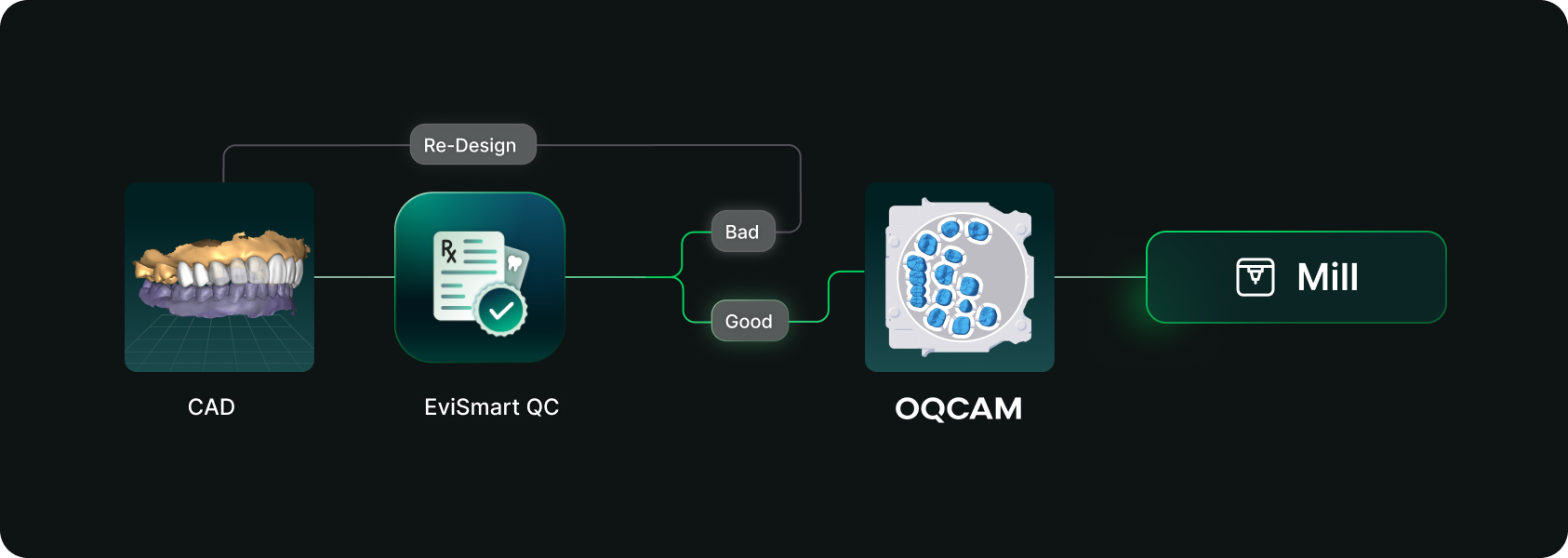
Designs you order from EviSmart arrive in your Oqcam already formatted. Named the way your nesting rules expect, with shade and material attached, and pointed at the machine that case belongs on.
The routing is decided per case. An implant case sends the crown to the mill and puck you cut implant crowns on, and the model to the printer you print models on. Different case types, different machines, chosen automatically rather than by a tech working through a dropdown for every file.
The trigger is QC approval. EviSmart designs your cases your way. The same team works on all your cases and learns what a good case looks like to you. Once your case passes our QC, it triggers a greenlight to send the design directly into your Oqcam account in under a minute.
Once the file arrives in your Oqcam, all your CAD/CAM technicians can review the nested design before starting the mill. That final QC step does not change and is not meant to.
Setup is one session. We connect your Oqcam account and agree where each of your products should go, using the routes and materials you have already built there. Nothing new to create, and you only revisit it if something changes.
Automatic sending only works if you trust what is being sent. Once a case is nested it gets cut, and a design that was not right is wasted material.
You choose what flows. During setup we map only the case types you want moving on their own. Anything unmapped never sends. It waits for you exactly as it does today.
Most labs start narrow. Bread and butter work first, night guards and posterior single units, then widen once they have watched it run for a few weeks. The lab that has been live longest started exactly there and has added case types since.
Your approval stays. This removes the file shuffling between design and CAM. It does not remove your eyes from the build.
For labs outsourcing design work the math gets compelling somewhere north of 30 cases a day into nesting, because that is where the handoff stops being an annoyance and starts being a role.
Not touchless design. Touchless handoff. Every step in that chain that requires judgment should keep requiring judgment, and every step that never did should stop requiring a person.
Nesting requires judgment. Confirming a build requires judgment. Renaming a file so software can read it does not, and never did. It was a workaround that quietly became somebody's job.
Nobody pays you to rename files.




