

The days of winning a new dental client with a perfectly crafted PFM crown and a competitive price list are over. The modern dental landscape is a complex ecosystem defined by rapid technological advancement, significant economic pressures, and evolving patient expectations.1 Dentists today are not just clinicians; they are business owners grappling with staffing shortages, rising overhead costs, and the challenge of integrating a dizzying array of digital tools into their practice.4
In this environment, the relationship between the dentist and the dental lab is being fundamentally redefined. To attract and retain the best dentists, labs must evolve beyond the role of a simple manufacturer. They must become indispensable digital partners who actively solve their clients' most pressing problems: efficiency, profitability, and predictability.7
This guide outlines four key strategies for dental labs to not only survive but thrive by demonstrating undeniable value to the modern, tech-savvy dentist.
The modern dental practice is increasingly digital. With intraoral scanner penetration now exceeding 57% in the U.S. and 3D printing becoming more common than in-office mills, dentists need lab partners who are not just participants but experts in the digital workflow.9 A lab that can confidently navigate CAD/CAM systems, advanced materials, and integrated software platforms immediately positions itself as a leader.
The next frontier is Artificial Intelligence (AI). AI is rapidly moving from diagnostics into the core of restorative dentistry, automating and enhancing treatment planning and prosthetic design.11 AI algorithms can now analyze digital impressions, suggest optimal designs for crowns and bridges, and even predict the longevity of restorations.
A lab that leverages these tools demonstrates a commitment to precision and efficiency. This is where a platform like EviSmart becomes a powerful differentiator. By leveraging EviSmart CAD with AI-powered design proposals, a lab can show prospective clients that it is at the forefront of technology, using intelligent automation to deliver highly accurate and consistent results. This fluency signals to a dentist that the lab is not just keeping up with trends but is a valuable resource capable of navigating the future of dentistry.
For a dental practice owner, lab fees are one of the largest variable expenses, typically accounting for 8-12% of production costs. However, the most forward-thinking labs are reframing this conversation from cost to profitability. The key is to demonstrate a clear and compelling Return on Investment (ROI) by focusing on the one thing dentists value most: efficiency.
A lab that embraces a fully digital workflow can offer its clients significant, quantifiable savings that go far beyond the price per unit:
An AI-powered gatekeeper like EviSmart QC automatically analyzes incoming scans for common errors like unclear margins or bite misalignments, preventing costly errors before they enter production.14 By presenting this as a service that protects the dentist's chair time and profitability, the lab transforms from a simple expense into a strategic partner in the practice's financial success.
An intraoral scan is more than a digital impression; it's a rich dataset. Labs that understand this can move "upstream" in the treatment process, offering high-value services that make them indispensable to their clients.7
Offering these services transforms the lab's role from an order-taker to a collaborative treatment planner, creating a deep, "sticky" relationship that is difficult for competitors to break.
In a high-stress clinical environment, dentists crave simplicity and predictability. The lab that is easiest to work with often wins the business. One of the biggest frustrations for dental offices is the fragmented and chaotic communication process—scattered emails, phone tag, and incompatible software systems that don't talk to each other.
This is where a universal automation platform like EviSmart becomes a lab's most powerful client acquisition tool. It is engineered to eliminate friction at every step of the workflow:
The dental industry is undergoing a profound transformation. Attracting and retaining the best dentists is no longer about having the lowest price per crown. It's about demonstrating value that directly impacts a practice's efficiency, profitability, and patient satisfaction. The modern dentist isn't just buying a restoration; they are buying predictability, expertise, and a frictionless workflow.
By becoming fluent in AI and digital technology, positioning themselves as a profit partner, offering value-added services, and delivering a seamless experience through platforms like EviSmart, dental labs can build unshakeable partnerships and secure their place as vital leaders in the future of dentistry.
EviSmart: Intelligently Connecting Dental Workflows. Simple. Powerful. Scalable.
I’m committed to helping dental labs navigate this shift with tools that drive real-world results — not hype.
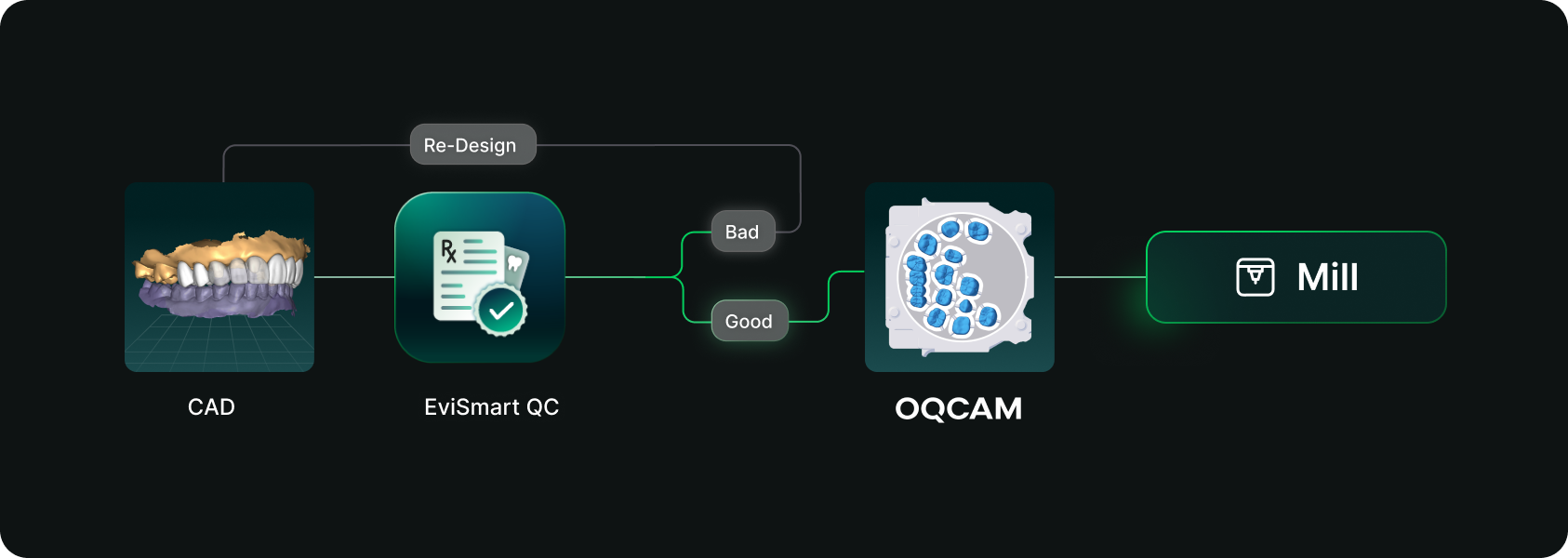
Designs you order from EviSmart arrive in your Oqcam already formatted. Named the way your nesting rules expect, with shade and material attached, and pointed at the machine that case belongs on.
The routing is decided per case. An implant case sends the crown to the mill and puck you cut implant crowns on, and the model to the printer you print models on. Different case types, different machines, chosen automatically rather than by a tech working through a dropdown for every file.
The trigger is QC approval. EviSmart designs your cases your way. The same team works on all your cases and learns what a good case looks like to you. Once your case passes our QC, it triggers a greenlight to send the design directly into your Oqcam account in under a minute.
Once the file arrives in your Oqcam, all your CAD/CAM technicians can review the nested design before starting the mill. That final QC step does not change and is not meant to.
Setup is one session. We connect your Oqcam account and agree where each of your products should go, using the routes and materials you have already built there. Nothing new to create, and you only revisit it if something changes.
Automatic sending only works if you trust what is being sent. Once a case is nested it gets cut, and a design that was not right is wasted material.
You choose what flows. During setup we map only the case types you want moving on their own. Anything unmapped never sends. It waits for you exactly as it does today.
Most labs start narrow. Bread and butter work first, night guards and posterior single units, then widen once they have watched it run for a few weeks. The lab that has been live longest started exactly there and has added case types since.
Your approval stays. This removes the file shuffling between design and CAM. It does not remove your eyes from the build.
For labs outsourcing design work the math gets compelling somewhere north of 30 cases a day into nesting, because that is where the handoff stops being an annoyance and starts being a role.
Not touchless design. Touchless handoff. Every step in that chain that requires judgment should keep requiring judgment, and every step that never did should stop requiring a person.
Nesting requires judgment. Confirming a build requires judgment. Renaming a file so software can read it does not, and never did. It was a workaround that quietly became somebody's job.
Nobody pays you to rename files.


