

When designing an All-on-X restoration, it's easy to focus on the fit, esthetics, and final appearance. But there's one design detail that deserves just as much attention: the pontic's tissue-facing contour. A ridge-lap pontic might look natural, but its design can make it difficult for patients to clean underneath their full-arch restoration. And the consequences can extend beyond food getting trapped.
Want to keep this guide next to your design screen?
The short version
A ridge-lap pontic is designed to overlap the residual ridge, creating a broad tissue-contacting surface.
While this can help reproduce the appearance of natural teeth, the concave underside can create areas that are difficult to access during daily cleaning. For patients with fixed All-on-X restorations, these areas can become traps for food debris and plaque.
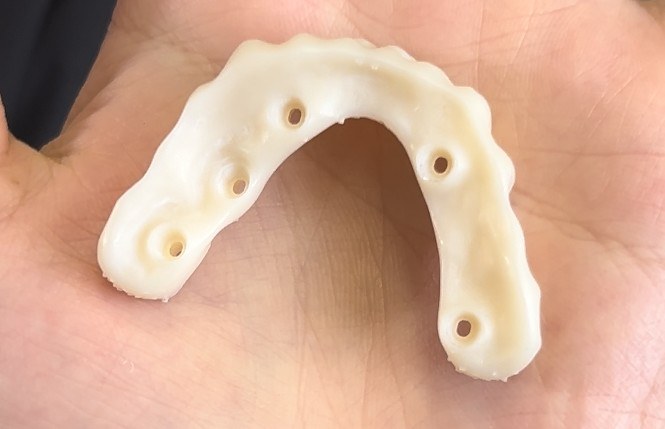
Key point: The concern isn't just how the pontic looks. It's whether the patient can effectively clean underneath it.
Poorly cleansable pontic contours can create several challenges for patients and dentists.
The concave tissue-facing surface of a ridge-lap pontic can make it harder for patients to remove trapped food and plaque. Even with regular brushing and dedicated cleaning aids, some areas may remain difficult to reach. This can make maintaining good oral hygiene underneath a fixed full-arch restoration more challenging.

Plaque accumulation around dental implants is a concern for long-term peri-implant health. When plaque is not adequately controlled, inflammation can develop around the implants.
This may contribute to peri-implant mucositis and, in susceptible patients, peri-implantitis, which involves the loss of supporting bone.
Ridge-lap design alone does not cause peri-implantitis. However, a restoration that makes effective cleaning difficult can contribute to conditions associated with peri-implant disease.
When patients struggle to maintain hygiene underneath their All-on-X restoration, additional professional cleaning and maintenance may be needed. That can mean more chair time for the dentist and additional appointments for the patient.
If the restoration's contour prevents adequate cleaning, modifications or a redesign may sometimes be necessary. In more significant cases, this could mean revisiting the prosthetic design and fabrication process.
Pro tip: A contour that's overlooked during CAD design can create maintenance challenges long after the restoration is delivered.
One approach is to use a smooth, convex, hygienic pontic contour instead of a concave ridge-lap design.
An appropriately designed ovate pontic has a rounded tissue-facing surface that can support esthetics while allowing for more favorable cleaning contours.

However, a true ovate pontic fits into a suitably shaped soft-tissue site. The appropriate design depends on the patient's anatomy and restorative requirements. For All-on-X restorations, the key is to create a tissue-facing contour that doesn't wrap unnecessarily around the ridge or create inaccessible areas.

A well-designed, cleansable contour can help:
The goal is a restoration that looks natural while remaining practical for the patient to maintain.
Before approving the final CAD design, take a closer look at the pontic's tissue-facing surface. Ask yourself:
Pay attention to the overall contour and whether the design creates areas that are difficult to access. Before you approve, check that:
Ridge-lap pontics can create concave surfaces that trap food and plaque, making daily oral hygiene more difficult. When possible, cleansable pontic contours are preferred for fixed full-arch implant restorations.
A ridge-lap pontic does not directly or inevitably cause peri-implantitis. However, poor cleaning access can encourage plaque accumulation, which is associated with peri-implant inflammation and disease.
Appropriately designed ovate or other smooth, convex contours may provide better cleaning access than broad, concave ridge-lap surfaces. The most suitable contour depends on the individual clinical case.
An All-on-X restoration shouldn't just look great on delivery day. It should also be designed for long-term maintenance. Ridge-lap pontics may create unnecessary hygiene challenges, while smooth, cleansable contours can make daily care more manageable.
Before approving your next All-on-X design, don't forget to check underneath the restoration.
Book your design ahead of surgery day and get real-time design turnaround, while you stay in control of the final design.

Printing your All-on-X cases in-house? Read 3 post-processing tips for ceramic-filled resin dental 3D prints.
Learn more about EviSmart CAD for Clinic.




