

“Remakes are just part of the business. I’m afraid to really look at the number. It feels like 4–5%.”
Sound familiar?
That’s the voice of almost every lab owner I know — including the old me.
We all carry that quiet fear: that if we look too closely at our remake rate, we’ll find something ugly. Something that says we’re failing. So, we call it a cost of doing business and move on.
But here’s the truth:
Your True Remake Rate (TRR) isn’t a cost of business.
It’s the cost of fear — the price you pay for avoiding hard, data-driven conversations with your clients.
The Psychologist’s Truth
If you think your remake rate is 5%, it’s probably closer to 8%. And that extra 3% isn’t just eating your profit — it’s poisoning your culture.
I’ve been there. I’ve stared at a $20,000 monthly loss from remakes. But the financial hit was nothing compared to the emotional one.
Remakes create a cycle of blame and burnout:
Over time, that cycle breeds resentment and anxiety. It slowly kills your lab from the inside out.
The Emotional Side
You can’t have a calm, confident, and profitable lab if your team works under constant fear of the next “redo.” TRR is not just a number — it’s a mirror showing how your team handles imperfection, communication, and accountability.
The Financial Side
The data doesn’t lie: 82% of remakes come from errors that happen before the case enters the lab.
Bad scans. Incomplete Rxs. Unclear margins.
Which means 82% of your biggest anxiety is preventable.
Every day, labs accept poor-quality data to avoid upsetting clients and then ask technicians to perform miracles with it.
When the case comes back, the blame ricochets through the lab.
This isn’t “the cost of doing business.”
It’s the cost of fear-based leadership — and it’s keeping your lab from reaching that elusive 29% EBITDA you dream of.
Here’s how to start changing everything — in less than a month.
This is the hardest part: look at the data.
Track every remake — and, more importantly, the reason behind it.
Use an LMS or internal tracker that logs objective causes: margin error, missing Rx data, or scan distortion.
This is not about blame.
It’s about freedom — freeing your team from vague anxiety and freeing you from assumptions.
Data becomes your shield, not your weapon.
Stop being the “bad guy” who has to call dentists about bad scans.
You don’t need confrontation — you need a system that handles it for you.
A system doesn’t get emotional. It doesn’t have a tone.
It just presents the facts. Calmly. Professionally. Consistently.
EviSmart Comm and EviSmart QC were built for this exact problem.
Instead of confrontation, it helps:
“Dr. Jones, the AI flagged a potential issue on #14. Could you please review?”
Not:
“Your scan is bad.”
That small shift changes everything.
The Result: Calm, Control, and Cash Flow
Once you put the system in place, your True Remake Rate plummets.
You’ve replaced anxiety with automation — fear with flow.
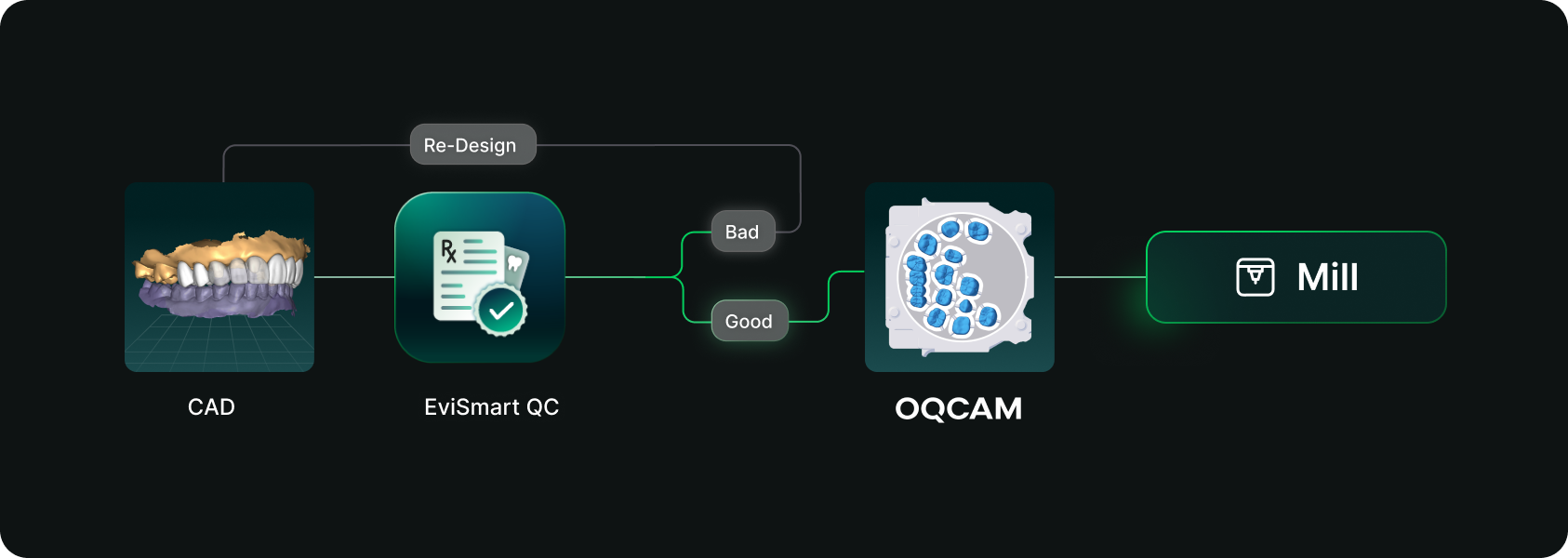
Designs you order from EviSmart arrive in your Oqcam already formatted. Named the way your nesting rules expect, with shade and material attached, and pointed at the machine that case belongs on.
The routing is decided per case. An implant case sends the crown to the mill and puck you cut implant crowns on, and the model to the printer you print models on. Different case types, different machines, chosen automatically rather than by a tech working through a dropdown for every file.
The trigger is QC approval. EviSmart designs your cases your way. The same team works on all your cases and learns what a good case looks like to you. Once your case passes our QC, it triggers a greenlight to send the design directly into your Oqcam account in under a minute.
Once the file arrives in your Oqcam, all your CAD/CAM technicians can review the nested design before starting the mill. That final QC step does not change and is not meant to.
Setup is one session. We connect your Oqcam account and agree where each of your products should go, using the routes and materials you have already built there. Nothing new to create, and you only revisit it if something changes.
Automatic sending only works if you trust what is being sent. Once a case is nested it gets cut, and a design that was not right is wasted material.
You choose what flows. During setup we map only the case types you want moving on their own. Anything unmapped never sends. It waits for you exactly as it does today.
Most labs start narrow. Bread and butter work first, night guards and posterior single units, then widen once they have watched it run for a few weeks. The lab that has been live longest started exactly there and has added case types since.
Your approval stays. This removes the file shuffling between design and CAM. It does not remove your eyes from the build.
For labs outsourcing design work the math gets compelling somewhere north of 30 cases a day into nesting, because that is where the handoff stops being an annoyance and starts being a role.
Not touchless design. Touchless handoff. Every step in that chain that requires judgment should keep requiring judgment, and every step that never did should stop requiring a person.
Nesting requires judgment. Confirming a build requires judgment. Renaming a file so software can read it does not, and never did. It was a workaround that quietly became somebody's job.
Nobody pays you to rename files.


