

On October 13, 2025, the Nobel Prize in Economics was awarded for the theory of creative destruction — the idea that outdated systems must collapse to make room for better ones.
If you’ve run a dental lab in the past decade, you know this wasn’t just academic. You lived it.
And if you’re still here? You’re not just lucky. You’re a survivor. And now, you have the opportunity to become a builder of what’s next.
U.S. dental labs have declined from over 17,500 to fewer than 6,500. That’s a 60%+ collapse. Entire families exited the business. Master technicians retired early. Entire regions went dark.
But here’s what never declined:
This isn’t the end. This is the biggest opportunity in decades.
For years, dental professionals feared that chairside milling and digital dentistry would replace labs. It didn’t.
The true disruption came from within.
Labs didn’t fall behind because of technology — they fell behind because of fragmented systems, manual workflows, and communication gaps that slowed down delivery and eroded profit margins.
The labs that survived didn’t just buy new equipment — they reengineered how work flowed.
They automated repetitive steps, centralized their data, and streamlined every handoff from dentist to delivery.
They replaced manual chaos with digital clarity.
Think about why people trust Amazon.
Every order is visible. Every delivery is predictable. Every experience feels seamless.
That same logic now defines the next generation of dental labs.
Labs that offer transparency, consistency, and speed are winning new business — not because they’re the biggest, but because they’re the most reliable.
They’ve learned that predictability builds trust, and trust fuels referrals.
That’s how modern labs grow — even when others are cutting back.
The top labs today don’t guess.
They run their operations with real-time visibility, automated workflows, and AI-supported quality control — ensuring every case flows seamlessly from scan to delivery.
Here’s how they’re putting the Amazon mindset into practice:
Each of these systems reduces friction, improves accuracy, and protects profitability.
You don’t need to be the largest lab in the country to scale profitably.
You just need systems that make growth sustainable.
Start with this mindset shift:
Labs that embrace these principles are seeing higher margins, faster turnaround times, and more consistent referrals — even in a shrinking industry.
This isn’t just survival. It’s strategy.
The market is growing again — just not in the same way it used to.
Labs that adapt now will define the next decade of dentistry.
If you’ve weathered the storm, you’ve already proven your resilience.
Now it’s time to turn that resilience into momentum, structure, and scale.
The future belongs to the labs that move smarter — where work truly flows.
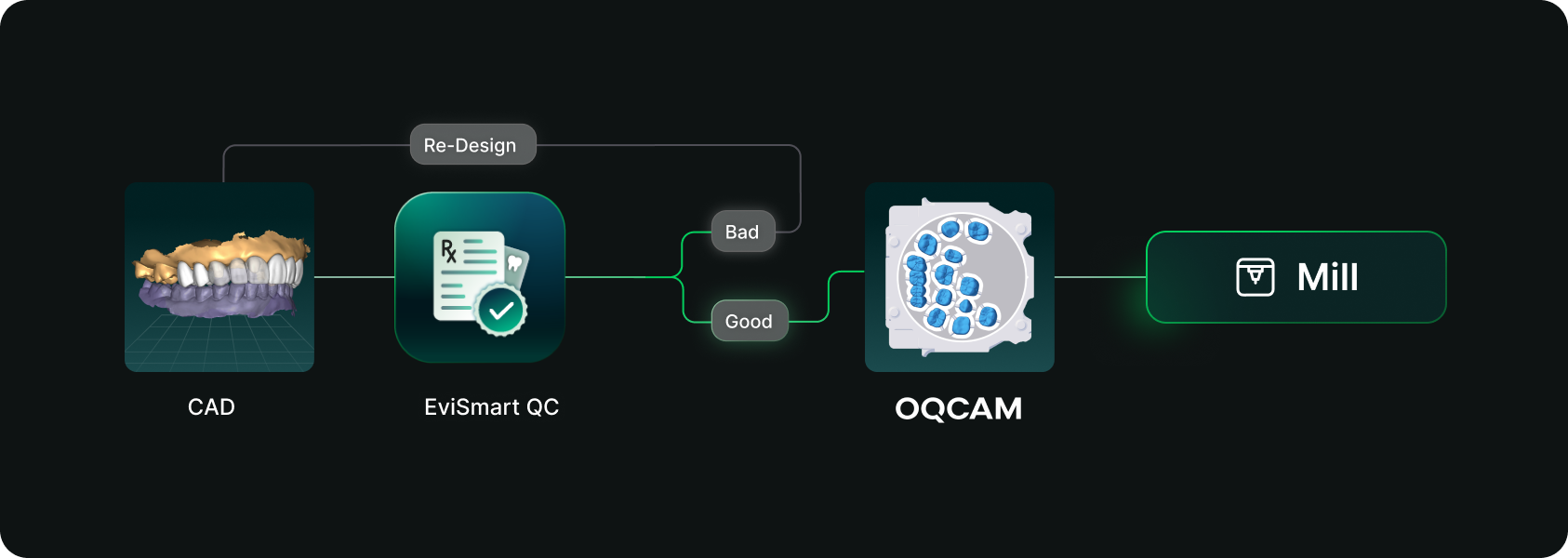
Designs you order from EviSmart arrive in your Oqcam already formatted. Named the way your nesting rules expect, with shade and material attached, and pointed at the machine that case belongs on.
The routing is decided per case. An implant case sends the crown to the mill and puck you cut implant crowns on, and the model to the printer you print models on. Different case types, different machines, chosen automatically rather than by a tech working through a dropdown for every file.
The trigger is QC approval. EviSmart designs your cases your way. The same team works on all your cases and learns what a good case looks like to you. Once your case passes our QC, it triggers a greenlight to send the design directly into your Oqcam account in under a minute.
Once the file arrives in your Oqcam, all your CAD/CAM technicians can review the nested design before starting the mill. That final QC step does not change and is not meant to.
Setup is one session. We connect your Oqcam account and agree where each of your products should go, using the routes and materials you have already built there. Nothing new to create, and you only revisit it if something changes.
Automatic sending only works if you trust what is being sent. Once a case is nested it gets cut, and a design that was not right is wasted material.
You choose what flows. During setup we map only the case types you want moving on their own. Anything unmapped never sends. It waits for you exactly as it does today.
Most labs start narrow. Bread and butter work first, night guards and posterior single units, then widen once they have watched it run for a few weeks. The lab that has been live longest started exactly there and has added case types since.
Your approval stays. This removes the file shuffling between design and CAM. It does not remove your eyes from the build.
For labs outsourcing design work the math gets compelling somewhere north of 30 cases a day into nesting, because that is where the handoff stops being an annoyance and starts being a role.
Not touchless design. Touchless handoff. Every step in that chain that requires judgment should keep requiring judgment, and every step that never did should stop requiring a person.
Nesting requires judgment. Confirming a build requires judgment. Renaming a file so software can read it does not, and never did. It was a workaround that quietly became somebody's job.
Nobody pays you to rename files.


