

Most lab messaging leans on fear: “the industry is changing.”
This report takes a different stance: the next decade isn’t a crisis—it’s an opportunity… if you’re ready.
The headline claim is bold: 75% more revenue per surviving lab by 2031, not because labs magically improve, but because more demand flows to fewer labs with capacity.
The report cites ongoing lab decline (~2.8%/year) with projections trending toward ~5,100 labs by 2031—meaning less competition for labs that survive and invest.
US lab revenue is ~$7.3B today, growing (baseline) and reaching $9.5–$10.5B by 2031 with the demographic surge.
By 2030, 73 million Americans will be 65+, and unlike prior generations, many are keeping their teeth—driving more crowns, implants, and full-arch restorations.
This is critical because complex cases are the profit engine: the report notes implant/full-arch work can be multiples of standard crown revenue (and time).
The report’s core argument: in the Golden Age, the scarce resource isn’t demand—it’s capacity. Manual workflows consume 10–12 hours/day of non-production time across entry, portals, QC, comms, and rework—leaving many labs operating at ~65–70% effective capacity.
Automation recovers those hours and redirects them to production, pushing capacity toward ~85–90% and enabling ~25–40% throughput gains without hiring.
The report frames a permanent split:
This blog is a high-level summary. The full PDF includes the demand math, capacity equation, and a 2026–2027 action plan to capture displaced volume and win DSO relationships before contracts lock in.
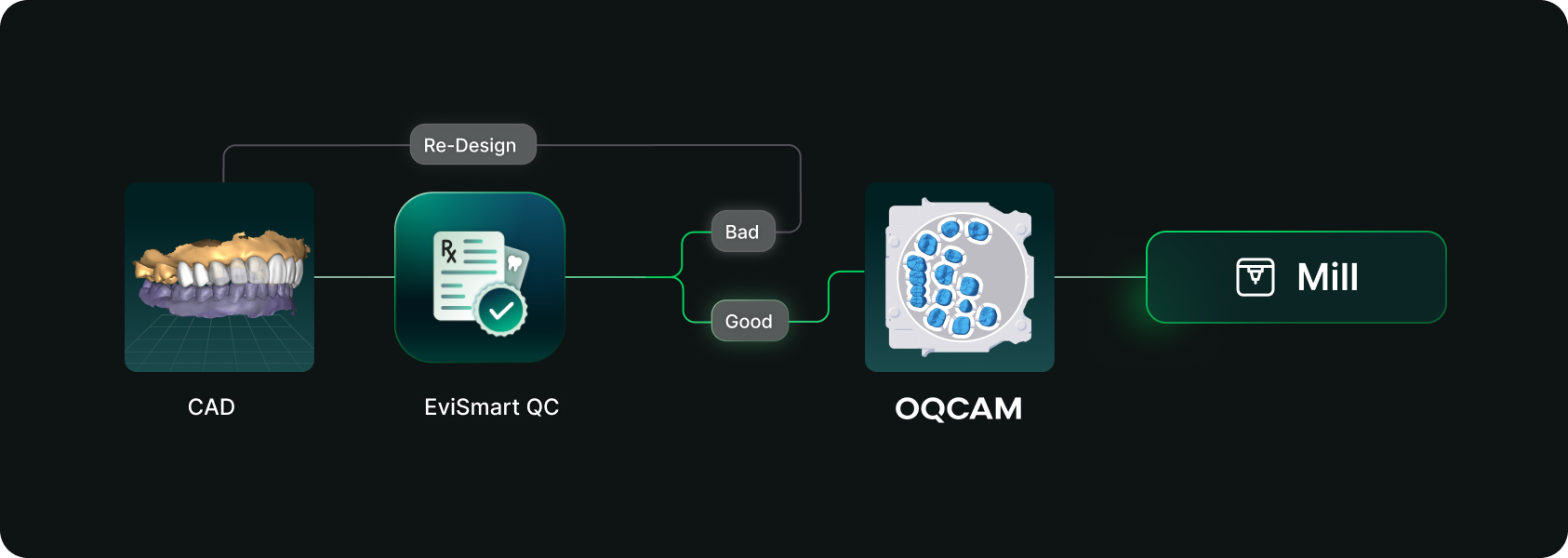
Designs you order from EviSmart arrive in your Oqcam already formatted. Named the way your nesting rules expect, with shade and material attached, and pointed at the machine that case belongs on.
The routing is decided per case. An implant case sends the crown to the mill and puck you cut implant crowns on, and the model to the printer you print models on. Different case types, different machines, chosen automatically rather than by a tech working through a dropdown for every file.
The trigger is QC approval. EviSmart designs your cases your way. The same team works on all your cases and learns what a good case looks like to you. Once your case passes our QC, it triggers a greenlight to send the design directly into your Oqcam account in under a minute.
Once the file arrives in your Oqcam, all your CAD/CAM technicians can review the nested design before starting the mill. That final QC step does not change and is not meant to.
Setup is one session. We connect your Oqcam account and agree where each of your products should go, using the routes and materials you have already built there. Nothing new to create, and you only revisit it if something changes.
Automatic sending only works if you trust what is being sent. Once a case is nested it gets cut, and a design that was not right is wasted material.
You choose what flows. During setup we map only the case types you want moving on their own. Anything unmapped never sends. It waits for you exactly as it does today.
Most labs start narrow. Bread and butter work first, night guards and posterior single units, then widen once they have watched it run for a few weeks. The lab that has been live longest started exactly there and has added case types since.
Your approval stays. This removes the file shuffling between design and CAM. It does not remove your eyes from the build.
For labs outsourcing design work the math gets compelling somewhere north of 30 cases a day into nesting, because that is where the handoff stops being an annoyance and starts being a role.
Not touchless design. Touchless handoff. Every step in that chain that requires judgment should keep requiring judgment, and every step that never did should stop requiring a person.
Nesting requires judgment. Confirming a build requires judgment. Renaming a file so software can read it does not, and never did. It was a workaround that quietly became somebody's job.
Nobody pays you to rename files.




