
There is a number that almost no dental lab tracks, and it may be the single most important figure in your business: revenue per full-time equivalent employee.
It's not cases per day. Not turnaround time. Not customer count. Those metrics tell you how busy you are. Revenue per employee tells you how profitable you actually are — and whether your growth is actually working.
According to benchmarking data from over 2,000 dental labs, the gap between the top performers and the bottom quartile is not a rounding error. It is a 4x difference. And it is getting wider every year.
A top-5% lab generating $5M in annual revenue operates with 13–17 employees and posts $1.75M–$2.25M in EBITDA. A bottom-quartile lab generating the same $5M operates with 42–63 employees and is barely breaking even.
Same revenue. Same market. One lab is printing money. The other is working twice as hard to stand still.
The top-5% lab generates $350,000–$400,000 in revenue per employee and runs at 35–45% EBITDA margins. The bottom-quartile lab generates under $120,000 per employee. The gap isn't explained by talent, location, case mix, or dentist relationships. It comes down to one thing: how much of the case lifecycle runs on automation versus manual labor.
Most lab owners respond to growing demand the same way: they hire. It feels logical. But in today's environment, it's quietly destroying margins.
A $42,000 technician hire fully loaded with payroll taxes, workers' comp, training, and overhead actually costs $65,000–$79,000. And the real problem isn't the cost. It's what each additional hire actually produces.
The first 15 employees in a lab handle core production and generate the highest output. After that, each new hire tends to fill administrative, supervisory, or redundant roles. Past 40 employees, a new hire generating $80,000–$110,000 in revenue barely covers their own cost. Cross the ACA's 50-employee threshold and mandatory health insurance kicks in on your entire workforce, pushing the math firmly into negative territory.
Revenue grows. Headcount grows faster. Margins compress. The lab gets busier and less profitable at the same time.
"We kept hiring to keep up with demand. Revenue was up 25%, but profit was flat. We were running faster just to stand still." — Lab Owner, Southwest U.S.
The labs at $400,000 per employee aren't smarter or better at dentistry. They made one structural decision: invest in systems before staffing.
The workflow differences are concrete. Bottom-quartile labs spend 2–4 hours per day manually logging into portals to download scans. Top-5% labs auto-download from every portal automatically. Bottom-quartile labs transcribe prescriptions by hand. Top-5% labs use AI to read and enter cases, with humans reviewing exceptions only. Bottom-quartile designers spend 25–45 minutes per crown. Top-5% labs produce AI-assisted designs in under 10 minutes total.
None of this requires extraordinary capital or proprietary technology. It requires a decision most lab owners haven't made explicitly yet.
A lab that automates can remove approximately $530,000 in annual cost from a $5M operation, improving EBITDA by 10 points. The automation investment that delivers this typically runs $60,000–$150,000 per year, a 3.5–8.8x return in Year 1 alone.
And it doesn't stop there. Faster turnaround and fewer errors attract more cases. Labs that pair automation with revenue growth see EBITDA move from $1M to $2M+ within 18–24 months. Meanwhile, the manual lab keeps hiring, keeps compressing margins, and keeps falling further behind.
After five years, the performance gap between these two labs is effectively unbridgeable.
Divide your last 12 months of revenue by your full-time equivalent headcount. If that number is under $120,000, you have a significant opportunity. If it's between $120,000 and $200,000, you've made a start. If it's above $200,000, you're ahead of most labs in the country — but the full report will show you exactly how far the top 5% has pulled ahead, and what it would take to close that gap.
The full report includes the complete benchmarking breakdown by tier, the EBITDA bridge model, and a self-assessment diagnostic so you can see exactly where your lab stands today.
Download the full report to get the financial models, benchmarks, and diagnostic framework.
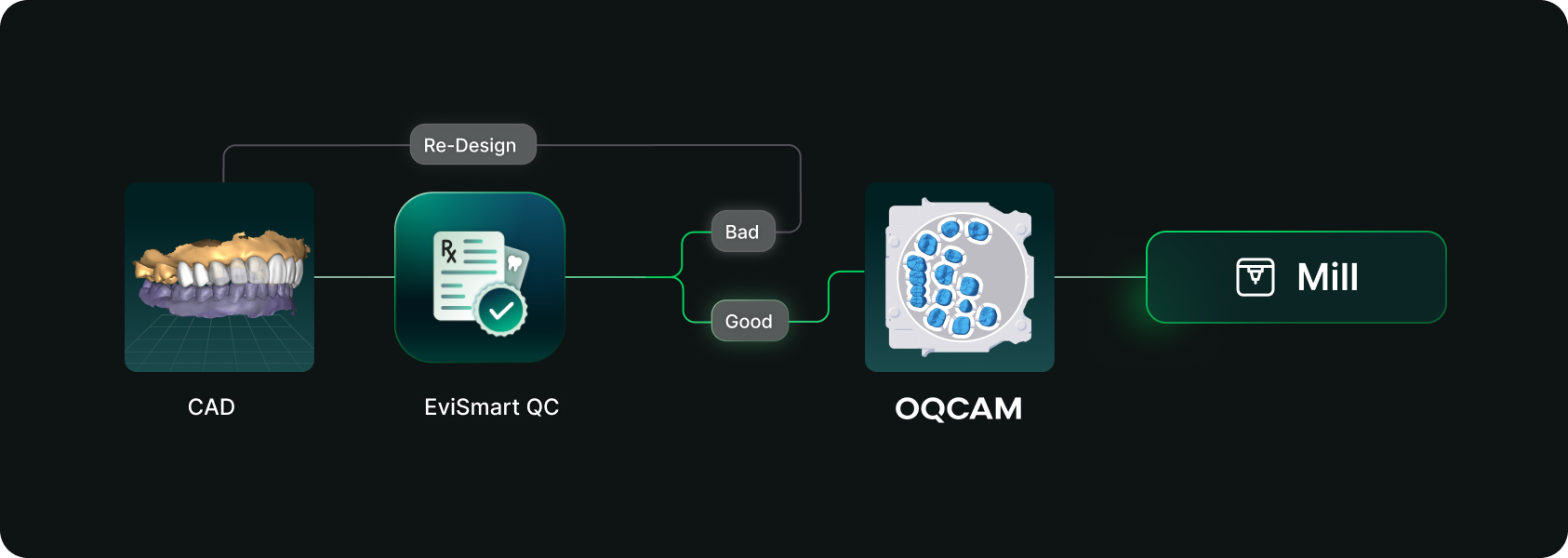
Designs you order from EviSmart arrive in your Oqcam already formatted. Named the way your nesting rules expect, with shade and material attached, and pointed at the machine that case belongs on.
The routing is decided per case. An implant case sends the crown to the mill and puck you cut implant crowns on, and the model to the printer you print models on. Different case types, different machines, chosen automatically rather than by a tech working through a dropdown for every file.
The trigger is QC approval. EviSmart designs your cases your way. The same team works on all your cases and learns what a good case looks like to you. Once your case passes our QC, it triggers a greenlight to send the design directly into your Oqcam account in under a minute.
Once the file arrives in your Oqcam, all your CAD/CAM technicians can review the nested design before starting the mill. That final QC step does not change and is not meant to.
Setup is one session. We connect your Oqcam account and agree where each of your products should go, using the routes and materials you have already built there. Nothing new to create, and you only revisit it if something changes.
Automatic sending only works if you trust what is being sent. Once a case is nested it gets cut, and a design that was not right is wasted material.
You choose what flows. During setup we map only the case types you want moving on their own. Anything unmapped never sends. It waits for you exactly as it does today.
Most labs start narrow. Bread and butter work first, night guards and posterior single units, then widen once they have watched it run for a few weeks. The lab that has been live longest started exactly there and has added case types since.
Your approval stays. This removes the file shuffling between design and CAM. It does not remove your eyes from the build.
For labs outsourcing design work the math gets compelling somewhere north of 30 cases a day into nesting, because that is where the handoff stops being an annoyance and starts being a role.
Not touchless design. Touchless handoff. Every step in that chain that requires judgment should keep requiring judgment, and every step that never did should stop requiring a person.
Nesting requires judgment. Confirming a build requires judgment. Renaming a file so software can read it does not, and never did. It was a workaround that quietly became somebody's job.
Nobody pays you to rename files.




