

Most dental labs don’t start outsourcing CAD because they want to.
They do it because volume increases, digital cases pile up, and internal CAD teams hit capacity.
Outsourcing becomes the pressure valve.
But here’s the part a lot of labs don’t anticipate:
as outsourcing volume grows, the work can start to feel less like their lab.
Not wrong.
Not unusable.
Just… different.
And dentists notice.
When business is good, pressure shows up fast.
More cases come in.
Turnaround gets tighter.
Internal designers are already stretched.
Hiring sounds like the obvious answer, until reality sets in:
So labs outsource.
Overflow at first.
Then more.
Outsourcing itself isn’t the mistake.
Outsourcing without protecting consistency is.
The goal of outsourcing is simple:
add capacity without changing how things feel to your dentists.
This is where most outsourcing models break down.
As volume increases, cases move through queues.
Designers rotate.
Each case is treated like a clean slate.
The result isn’t bad design.
It’s average design.
Contacts that are slightly different than last time.
Occlusion that needs adjustment again.
Contours that don’t quite match what the dentist expects.
Nothing is technically “wrong.”
It just doesn’t fit the way it used to.
That gap — between acceptable and familiar — is where confidence starts to slip.
From a dentist’s perspective, the best lab is the one they don’t have to think about.
They don’t want to re-explain preferences.
They don’t want to double-check every seat.
They don’t want surprises chairside.
When outcomes feel predictable, dentists relax.
When they relax, they stop shopping.
That’s not about loyalty programs or pricing.
That’s about trust.
And trust drives repeat business.
Generic outsourcing is optimized for throughput, not familiarity.
Cases get done.
Files come back.
The backlog clears.
But the lab’s “signature” — the way things normally look and feel — starts to blur.
When that happens:
Growth doesn’t stop overnight.
It just gets harder.
Labs end up chasing more volume to make up for weaker retention.
EviSmart approaches outsourced CAD differently.
We don’t treat each case as an isolated task.
We treat it as part of an ongoing relationship between your lab and your dentists.
If one dentist prefers tight contacts, that becomes the standard.
If another wants heavier occlusion, that’s designed in from the start.
If a doctor hates bulky contours, that preference carries forward.
Those details don’t live in emails or get re-explained every time.
They’re built into how work gets done.
So when you outsource more cases, the results still fit what your dentists expect.
Outsourcing shouldn’t force labs to compromise their identity.
EviSmart’s CAD teams work to your standards, your materials, and your decision-making style.
Same interpretation.
Same design logic.
Same outcome — even as volume increases.
That’s how labs add capacity without becoming interchangeable.
Labs with consistent outcomes don’t just run smoother operations.
Every remake steals time from revenue-producing work.
Consistent CAD reduces:
Margins stay intact even as volume grows.
Dentists who trust outcomes:
That’s how growth compounds.
Most labs will outsource CAD in some form.
The question isn’t if.
It’s whether outsourcing strengthens the lab or slowly turns it generic.
Labs that scale well don’t outsource more.
They outsource in a way that preserves what makes them recognizable.
Their work still fits.
Their dentists still trust the outcome.
Their signature survives growth.
Outsourcing CAD isn’t the issue.
Outsourcing in a way that erases consistency and signature style is.
Labs that win long term aren’t the fastest or the cheapest.
They’re the ones whose restorations still feels the same, even as volume grows.
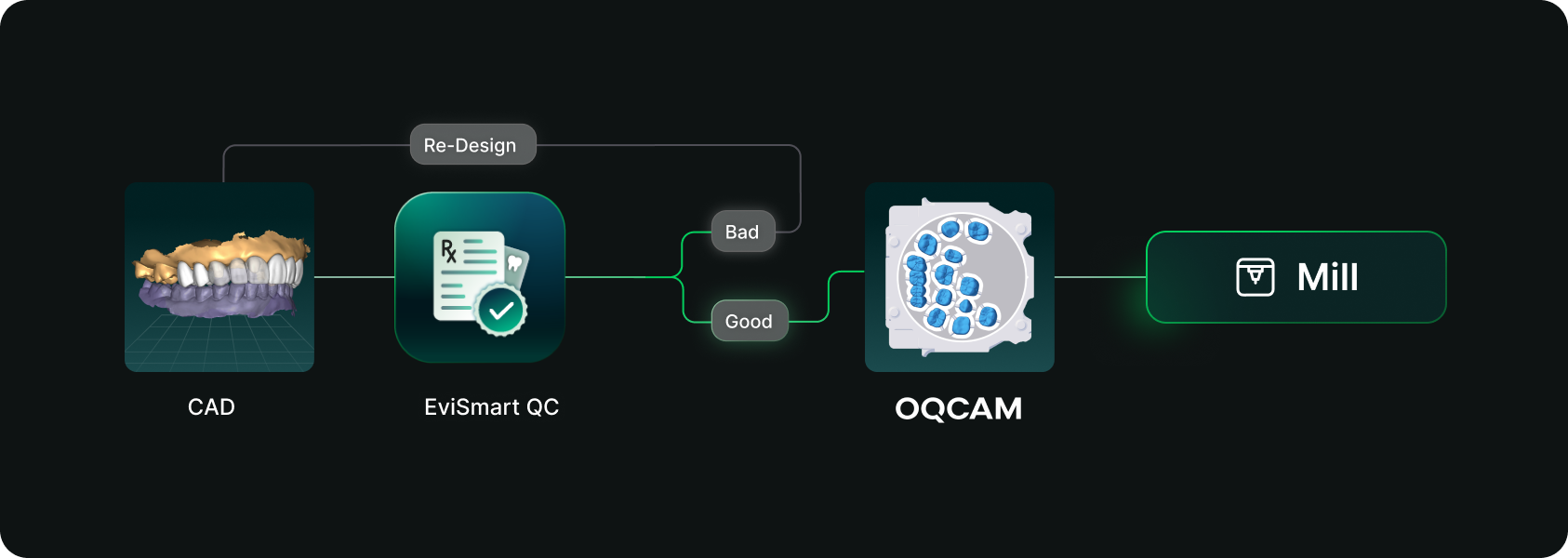
Designs you order from EviSmart arrive in your Oqcam already formatted. Named the way your nesting rules expect, with shade and material attached, and pointed at the machine that case belongs on.
The routing is decided per case. An implant case sends the crown to the mill and puck you cut implant crowns on, and the model to the printer you print models on. Different case types, different machines, chosen automatically rather than by a tech working through a dropdown for every file.
The trigger is QC approval. EviSmart designs your cases your way. The same team works on all your cases and learns what a good case looks like to you. Once your case passes our QC, it triggers a greenlight to send the design directly into your Oqcam account in under a minute.
Once the file arrives in your Oqcam, all your CAD/CAM technicians can review the nested design before starting the mill. That final QC step does not change and is not meant to.
Setup is one session. We connect your Oqcam account and agree where each of your products should go, using the routes and materials you have already built there. Nothing new to create, and you only revisit it if something changes.
Automatic sending only works if you trust what is being sent. Once a case is nested it gets cut, and a design that was not right is wasted material.
You choose what flows. During setup we map only the case types you want moving on their own. Anything unmapped never sends. It waits for you exactly as it does today.
Most labs start narrow. Bread and butter work first, night guards and posterior single units, then widen once they have watched it run for a few weeks. The lab that has been live longest started exactly there and has added case types since.
Your approval stays. This removes the file shuffling between design and CAM. It does not remove your eyes from the build.
For labs outsourcing design work the math gets compelling somewhere north of 30 cases a day into nesting, because that is where the handoff stops being an annoyance and starts being a role.
Not touchless design. Touchless handoff. Every step in that chain that requires judgment should keep requiring judgment, and every step that never did should stop requiring a person.
Nesting requires judgment. Confirming a build requires judgment. Renaming a file so software can read it does not, and never did. It was a workaround that quietly became somebody's job.
Nobody pays you to rename files.


