

Most dental lab owners think growth means adding more dentists, investing in expensive equipment, or hiring more technicians. But here’s the truth
The labs that consistently outperform their peers aren’t chasing size —they’re improving the earnings they generate from every single case.
The most successful labs know how to protect payroll, reduce waste, and turn operational control into stronger margins. Workflow automation is a powerful enabler of this shift, but the real difference lies in how leaders think about their business.
Here are five strategies top-performing labs use to increase earnings by 20–30% — without adding headcount or chasing more accounts.
Payroll is the single largest expense for most labs, yet a huge portion of it gets consumed by repetitive admin tasks like
Every hour spent here is an hour not spent on production.
High-performing labs protect payroll for production. They use workflow automation to
The result? The same team produces more value — and profit per employee rises.
Remakes quietly drain 3–5% of revenue across the dental lab industry.Every crown that comes back costs more than materials — it eats into technician time, disrupts schedules, and erodes client trust.
High-performing labs treat accuracy as a profit driver. By tightening quality checks and catching errors before cases leave the lab, they:
Every avoided remake directly protects profit margins. Tools like EviSmart QC make this easier by automating quality checks so labs can consistently deliver on-time, error-free cases.
Intake and admin staff often face the highest turnover in labs. Each resignation means
High-performing labs stabilize their workforce. They achieve this by:
The outcome is higher retention, lower hidden costs, and stronger institutional knowledge — all of which drive long-term profitability.
Scattered communication is one of the most common causes of delays in dental labs. When instructions live across multiple channels, important details slip through the cracks.
The cost? Missed deadlines, frustrated clients, and in the worst cases —lost accounts.
High-performing labs centralize communication and approvals. They use systems that make every instruction and comment transparent, trackable, and tied directly to each case.
The result is faster turnaround times and stronger client relationships — the foundation of recurring revenue and new referrals.
The most advanced labs see efficiency as more than just time saved. They see it as a core financial strategy.
Think about the numbers:
At scale, these improvements translate into tens of millions in added enterprise value.
High-performing labs think beyond today’s margin. Every small gain compounds — improving daily profitability while strengthening long-term business value.
The labs leading the industry aren’t necessarily the largest — they’re the smartest.
They know growth isn’t about chasing more accounts or hiring more staff. It’s about improving the profit they earn from the cases already flowing through their lab.
By:
They’ve built systems that consistently improve earnings by 20–30%.
Workflow automation makes this transformation possible, but the mindset shift comes first.
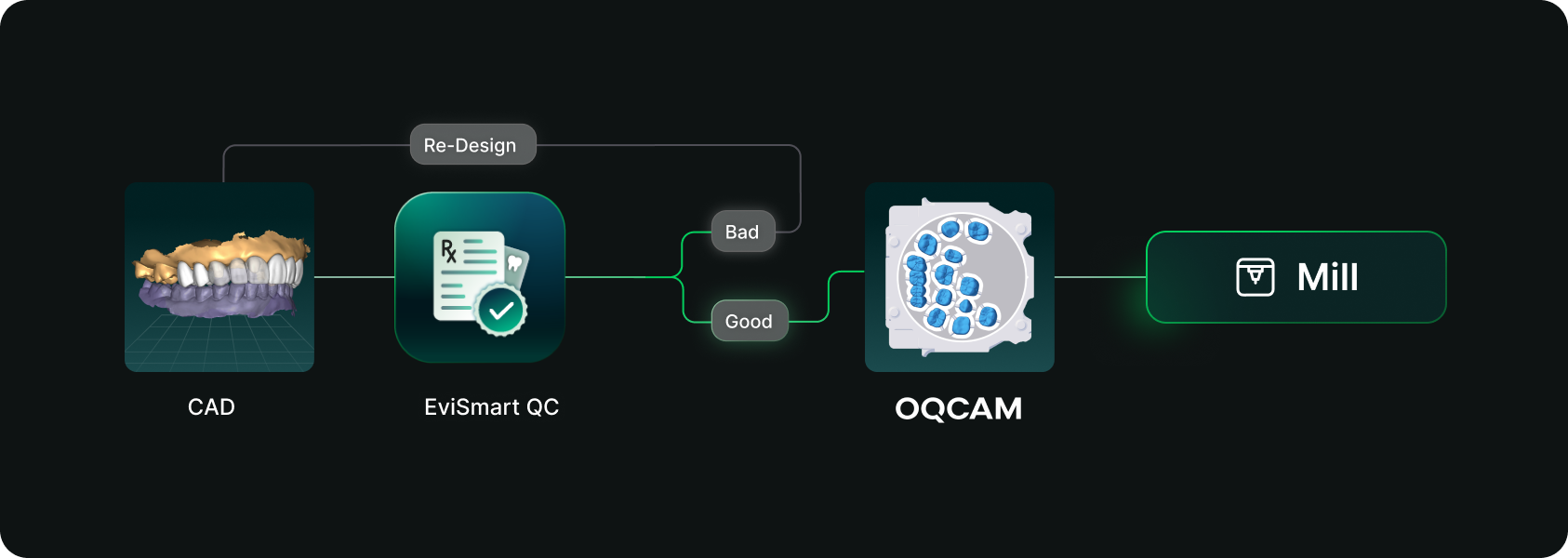
Designs you order from EviSmart arrive in your Oqcam already formatted. Named the way your nesting rules expect, with shade and material attached, and pointed at the machine that case belongs on.
The routing is decided per case. An implant case sends the crown to the mill and puck you cut implant crowns on, and the model to the printer you print models on. Different case types, different machines, chosen automatically rather than by a tech working through a dropdown for every file.
The trigger is QC approval. EviSmart designs your cases your way. The same team works on all your cases and learns what a good case looks like to you. Once your case passes our QC, it triggers a greenlight to send the design directly into your Oqcam account in under a minute.
Once the file arrives in your Oqcam, all your CAD/CAM technicians can review the nested design before starting the mill. That final QC step does not change and is not meant to.
Setup is one session. We connect your Oqcam account and agree where each of your products should go, using the routes and materials you have already built there. Nothing new to create, and you only revisit it if something changes.
Automatic sending only works if you trust what is being sent. Once a case is nested it gets cut, and a design that was not right is wasted material.
You choose what flows. During setup we map only the case types you want moving on their own. Anything unmapped never sends. It waits for you exactly as it does today.
Most labs start narrow. Bread and butter work first, night guards and posterior single units, then widen once they have watched it run for a few weeks. The lab that has been live longest started exactly there and has added case types since.
Your approval stays. This removes the file shuffling between design and CAM. It does not remove your eyes from the build.
For labs outsourcing design work the math gets compelling somewhere north of 30 cases a day into nesting, because that is where the handoff stops being an annoyance and starts being a role.
Not touchless design. Touchless handoff. Every step in that chain that requires judgment should keep requiring judgment, and every step that never did should stop requiring a person.
Nesting requires judgment. Confirming a build requires judgment. Renaming a file so software can read it does not, and never did. It was a workaround that quietly became somebody's job.
Nobody pays you to rename files.


