

There’s a question many master technicians are asking quietly:
“If AI can do it… what happens to my craft?”
Under that question is a deeper fear: “Am I becoming obsolete?”
But the report makes a sharper claim:
AI isn’t coming for your job.
AI is coming for the parts of your job you hate.
AI can handle the tedious, repeatable parts: data entry, routine designs, basic adjustments.
What it cannot match, now and for the foreseeable future is the human layer:
The report frames lab work as an 80/20 split:
The 80% (routine): standard single crowns, predictable anatomy, basic layering, standard shade matching, case management
The 20% (artistry): full-arch rehabs, challenging occlusion, custom characterization, difficult shades, doctor consultation/problem-solving
AI excels at the 80%.
You excel at the 20%.
So the real question isn’t “AI vs Technician.”
It’s: How do you use AI to spend more time on the work that actually requires you?
The most successful craftsmen adopt a new identity: Quality Gatekeeper.
Think of AI like a junior tech: it can do first-pass work fast, follow templates, and move routine cases forward.
But you would never let a junior tech ship without review. AI is the same.
The Gatekeeper workflow looks like this:
This is how craftsmanship survives automation: by focusing on where human expertise is irreplaceable.
The report shares a technician with 28 years’ experience who resisted digital workflows until 2022, worried tech would make him irrelevant.
After embracing AI as leverage, he processed 40% more cases than in 2021 with higher quality scores and fewer remakes.
His takeaway: when routine work becomes automated, expertise becomes more valuable, not less because it’s no longer wasted.
The report argues the industry is bifurcating:
The commodity side will automate. That’s inevitable.
The opportunity is choosing where you’ll sit: competing against automation, or controlling it.
This post is a high-level summary. The full PDF includes the complete “Quality Gatekeeper” model, the 80/20 framework, and how to position your lab/technicians for premium work in an automated era.
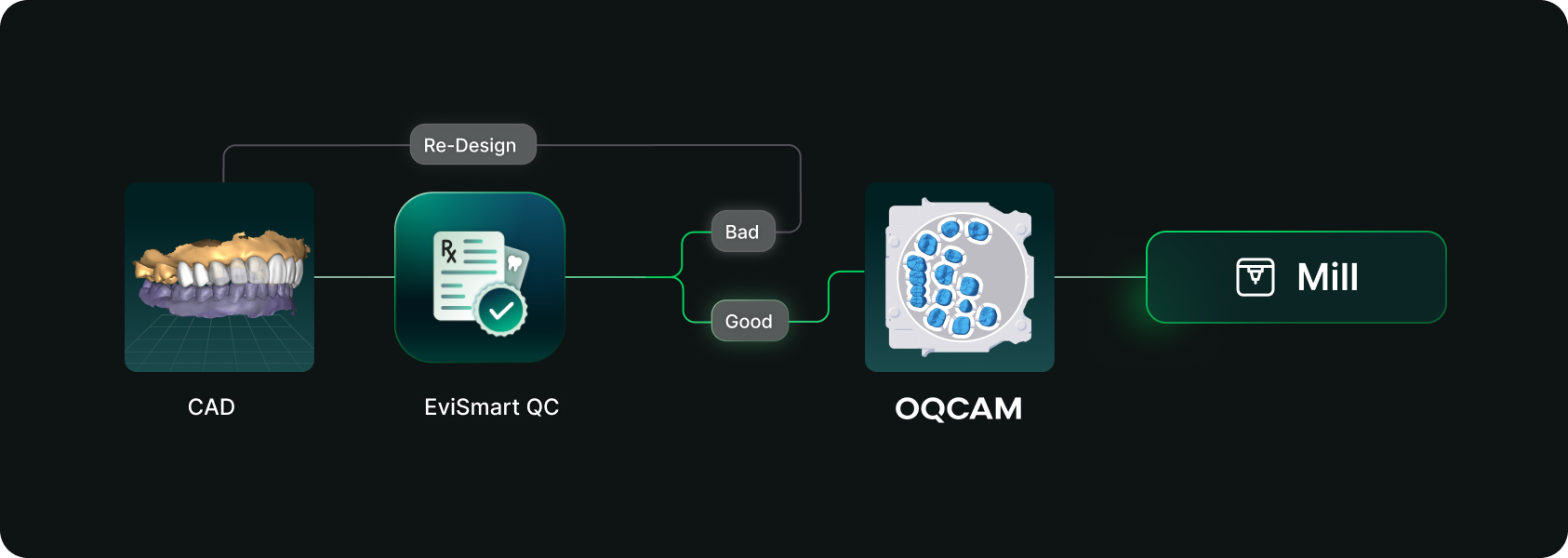
Designs you order from EviSmart arrive in your Oqcam already formatted. Named the way your nesting rules expect, with shade and material attached, and pointed at the machine that case belongs on.
The routing is decided per case. An implant case sends the crown to the mill and puck you cut implant crowns on, and the model to the printer you print models on. Different case types, different machines, chosen automatically rather than by a tech working through a dropdown for every file.
The trigger is QC approval. EviSmart designs your cases your way. The same team works on all your cases and learns what a good case looks like to you. Once your case passes our QC, it triggers a greenlight to send the design directly into your Oqcam account in under a minute.
Once the file arrives in your Oqcam, all your CAD/CAM technicians can review the nested design before starting the mill. That final QC step does not change and is not meant to.
Setup is one session. We connect your Oqcam account and agree where each of your products should go, using the routes and materials you have already built there. Nothing new to create, and you only revisit it if something changes.
Automatic sending only works if you trust what is being sent. Once a case is nested it gets cut, and a design that was not right is wasted material.
You choose what flows. During setup we map only the case types you want moving on their own. Anything unmapped never sends. It waits for you exactly as it does today.
Most labs start narrow. Bread and butter work first, night guards and posterior single units, then widen once they have watched it run for a few weeks. The lab that has been live longest started exactly there and has added case types since.
Your approval stays. This removes the file shuffling between design and CAM. It does not remove your eyes from the build.
For labs outsourcing design work the math gets compelling somewhere north of 30 cases a day into nesting, because that is where the handoff stops being an annoyance and starts being a role.
Not touchless design. Touchless handoff. Every step in that chain that requires judgment should keep requiring judgment, and every step that never did should stop requiring a person.
Nesting requires judgment. Confirming a build requires judgment. Renaming a file so software can read it does not, and never did. It was a workaround that quietly became somebody's job.
Nobody pays you to rename files.




