

“The winners of the AI revolution won’t be those who adopt the most tools — they’ll be those who design the smartest workflows.” — Paolo Kalaw
We’re past the phase where AI is a novelty. It’s here, it’s scaling, and it’s accelerating exponentially.
But while most companies obsess over model size and chatbot tricks, the real competitive advantage is emerging somewhere else:
Workflow interaction.
The future of productivity isn’t about replacing humans with AI — it’s about redesigning how humans and AI work together to scale intelligence, speed, and output.
AI progress is compounding across three dimensions:
1. Smarter Models: Large Language Models (LLMs) are improving 3–4x annually, with open-source players closing the performance gap.
2. Faster Hardware: GPUs and NPUs are doubling compute throughput every 6 months — “Hyper Moore’s Law” in full effect.
3. Massive Compute Investment: Entire data centers are now built solely to train and deploy AI at scale.
These forces don’t just add up — they multiply. But capability without integration leads to chaos, not productivity.
What’s missing in most AI transformation plans?
Workflow architecture.
Throwing AI on top of legacy systems is like putting a rocket engine on a horse cart.
Real transformation begins when companies:
• Map workflows by task type and AI potential.
• Reallocate human roles to focus on decision-making, oversight, and exception handling.
• Embed AI agents into core operations — from customer success to finance to R&D.
We’re not talking about surface-level automation. We’re talking about deep system reconfiguration.
This is where the conversation shifts from tools to strategy.
Imagine:
• AI copilots managing 90% of routine work.
• Humans focusing on critical judgment, strategy, and creativity.
• Feedback loops where AI improves workflows, and workflows improve AI.
That’s workflow symbiosis — and it’s the most underleveraged growth engine of this decade.
Yes, the U.S., China, EU, UAE, and Asia are in a global AI arms race. But raw model power alone won’t win.
The real strategic advantage lies in how seamlessly you can operationalize AI across people, processes, and platforms.
Recursive self-improvement isn’t sci-fi anymore. We’re already seeing:
• AI helping design more efficient chips.
• AI optimizing its own learning loops.
• Closed-loop systems improving faster than human teams can iterate.
This is the gateway to Artificial General Intelligence (AGI) and, possibly, Artificial Superintelligence (ASI). But even before we get there, the real business opportunity is to:
Build intelligent systems that adapt, evolve, and accelerate human potential.
Here’s the leadership blueprint:
1. Audit your workflows. What can be automated, augmented, or restructured?
2. Train for judgment, not repetition. Upskill your teams for AI fluency.
3. Design for orchestration. Build interfaces and systems where humans and AI collaborate seamlessly.
4. Measure impact. Focus on outcomes, not just implementation.
Workflow design is no longer an IT initiative.
It’s a strategic mandate.
And the organizations that master human-AI workflow integration will dominate their industries in the next 5 years.
---
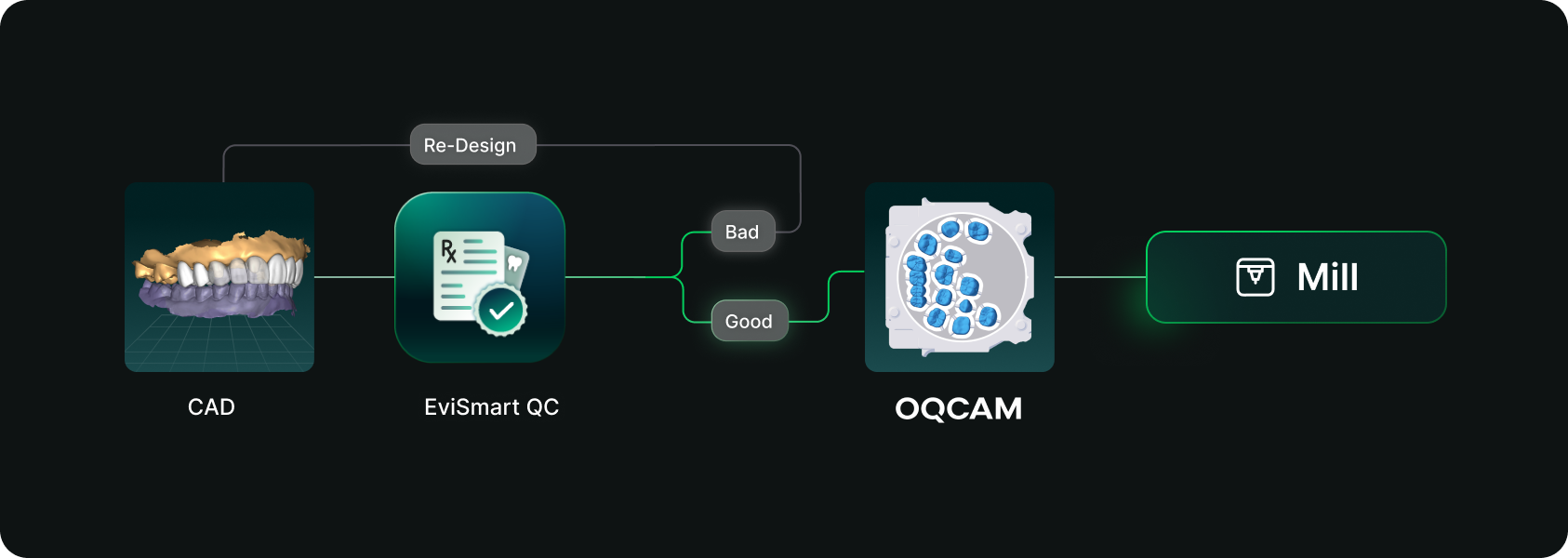
Designs you order from EviSmart arrive in your Oqcam already formatted. Named the way your nesting rules expect, with shade and material attached, and pointed at the machine that case belongs on.
The routing is decided per case. An implant case sends the crown to the mill and puck you cut implant crowns on, and the model to the printer you print models on. Different case types, different machines, chosen automatically rather than by a tech working through a dropdown for every file.
The trigger is QC approval. EviSmart designs your cases your way. The same team works on all your cases and learns what a good case looks like to you. Once your case passes our QC, it triggers a greenlight to send the design directly into your Oqcam account in under a minute.
Once the file arrives in your Oqcam, all your CAD/CAM technicians can review the nested design before starting the mill. That final QC step does not change and is not meant to.
Setup is one session. We connect your Oqcam account and agree where each of your products should go, using the routes and materials you have already built there. Nothing new to create, and you only revisit it if something changes.
Automatic sending only works if you trust what is being sent. Once a case is nested it gets cut, and a design that was not right is wasted material.
You choose what flows. During setup we map only the case types you want moving on their own. Anything unmapped never sends. It waits for you exactly as it does today.
Most labs start narrow. Bread and butter work first, night guards and posterior single units, then widen once they have watched it run for a few weeks. The lab that has been live longest started exactly there and has added case types since.
Your approval stays. This removes the file shuffling between design and CAM. It does not remove your eyes from the build.
For labs outsourcing design work the math gets compelling somewhere north of 30 cases a day into nesting, because that is where the handoff stops being an annoyance and starts being a role.
Not touchless design. Touchless handoff. Every step in that chain that requires judgment should keep requiring judgment, and every step that never did should stop requiring a person.
Nesting requires judgment. Confirming a build requires judgment. Renaming a file so software can read it does not, and never did. It was a workaround that quietly became somebody's job.
Nobody pays you to rename files.


